Rechercher dans ce blog

Friday, July 2, 2021

Never mind 5G. This is what 6G could look like - CNET

6g-logo-original-green-purple-blue
Sarah Tew/CNET

Carriers around the world have launched their 5G networks. Nationwide coverage is available in the US from the big three providers. Compatible smartphones are getting cheaper. The next-generation wireless technology is rapidly maturing. 

So let's talk about the next-next-generation wireless technology. Yes, 6G. 

Each wireless generation lasts about a decade, so 6G is a long, long way from becoming reality. Maybe in 2029 we'll get a hint of a deployment. Still, it's worth considering the technology that will be around the next corner and looking at what wireless researchers are thinking about in terms of its potential. 

5G won't stand still as 6G is developed. As wireless executives convened (virtually) at the Mobile World Congress conference this week, a separate group of researchers from hundreds of companies representing the 3GPP standard-setting body met to talk about 5G Advanced, a marketing buzzword coming to a commercial near you. 

Attending that discussion was Tingfang Ji, senior director of engineering at Qualcomm and one of the lead 5G researchers at the company. Ji, who holds more than 800 patents at Qualcomm, offered some insight into what both 5G Advanced and 6G technology might look like. 

6G will sense your environment

It's worth looking back before looking to the future. The move to 4G saw a big boost in speed. Now 5G offers greater connectivity for multiple devices, as well as breakneck speeds, particularly in city centers like Times Square and arenas such as football stadiums. While 6G will undoubtedly bring even higher speeds, a key benefit will be using those radios to sense your surroundings as well as to ferry information.

There's already work on this in 5G, with the phone's radio acting like a GPS device to figure out your location. With 6G, your phone will be able to figure out the devices around you, serving as a bridge between the physical and digital worlds. Those nifty augmented reality demos -- the ones that feature digital menus popping up on your eyeglasses screen when you look at a restaurant -- could materialize with 6G.

Apple already uses Bluetooth embedded in its network of devices to let people track objects with its AirTags. But Ji says the 6G experience will be more like radar, allowing for more interaction between devices. 

"You can actually sense the environment, so it should be more powerful," Ji said. 

With 6G, the industry is looking to expand into new bands of spectrum. Wireless carriers embraced gigahertz frequencies, which offer you a huge amount of speeds -- comparable to a speedy fiber landline connection -- but limited range. Ji said they were looking at terahertz spectrum, which operates at a frequency that's 1,000 times faster than gigahertz (which itself is 1,000 times faster than a megahertz). 

It's important to note that frequency doesn't exactly correspond to speed, but it gives you a sense of how much more capacity you could get with 6G. 

The next-next-generation technology could also solve the dilemma that gigahertz spectrum faces now. It could potentially offer both higher capacity and wider range in a best-of-both-worlds scenario. 

"There will be some fundamental technology we will want to introduce to overcome that," he said. "It's something we're working on that's super exciting."

What is 5G Advanced?

Work on 6G is just getting started. Right now, it's little more than a collection of ideas and goals. More concrete is the prospect of 5G Advanced, an upgraded version of 5G that could come in the next two and a half years. 

While no one knows for sure what it will consist of, there's industry movement to clarify the picture. At their meeting, researchers under the 3GPP group debated what improvements the industry should focus on. 

"5G Advanced gives us a second chance to look at the fundamental tradeoffs inside 5G," Ji said. 

There are 50 areas that researchers are looking at, but they will likely get narrowed to about 20, he added. 

Qualcomm has proposed integrating machine learning into 5G and for the networks to better handle internet of things devices. It's also proposing to use full duplex radios, in which both sides can communicate with each other simultaneously. (Typically, it's one-way traffic.) 

"There's a wide area where we can make a substantial boost to the technology," Ji said. 

The 3GPP organization counts 700 companies, including Apple, Google and Huawei, so what Qualcomm is proposing may not be what the industry focuses on. 

Again, this is technology that isn't going to show up in your phone for a while, so no need to hold off on that upgrade for 5G Advanced. And 6G, despite a sense of where it may go, is barely on the map. 

See also: Best 5G phones for 2021

Adblock test (Why?)


Never mind 5G. This is what 6G could look like - CNET
Read More

The best July 4th tech deals we could find - Engadget

All products recommended by Engadget are selected by our editorial team, independent of our parent company. Some of our stories include affiliate links. If you buy something through one of these links, we may earn an affiliate commission.

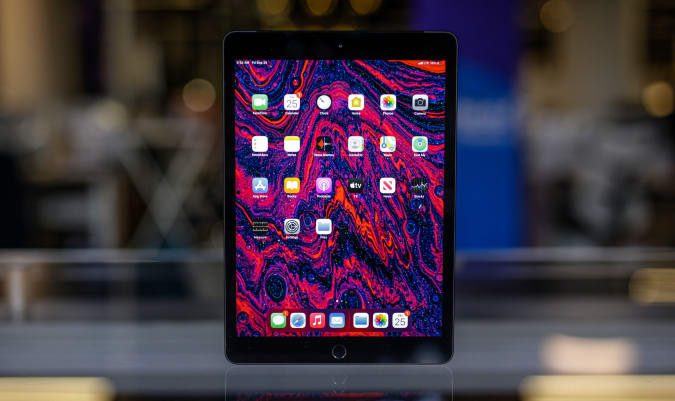
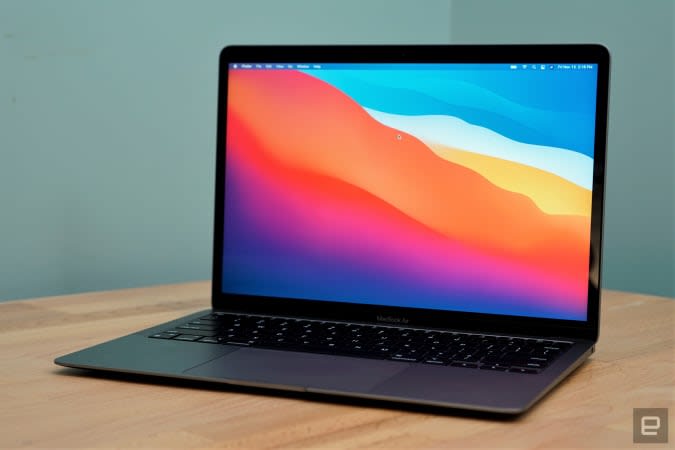
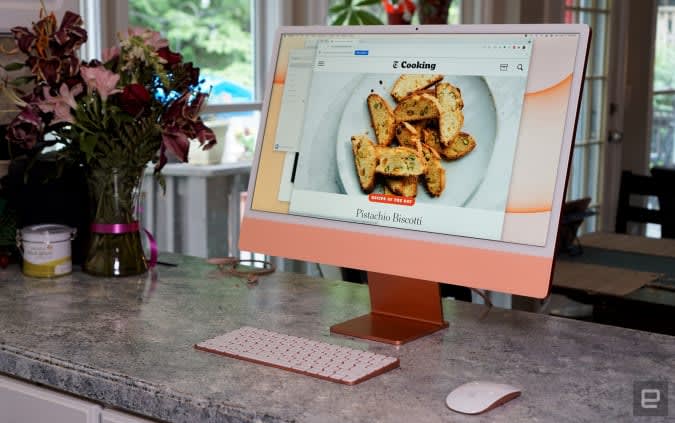
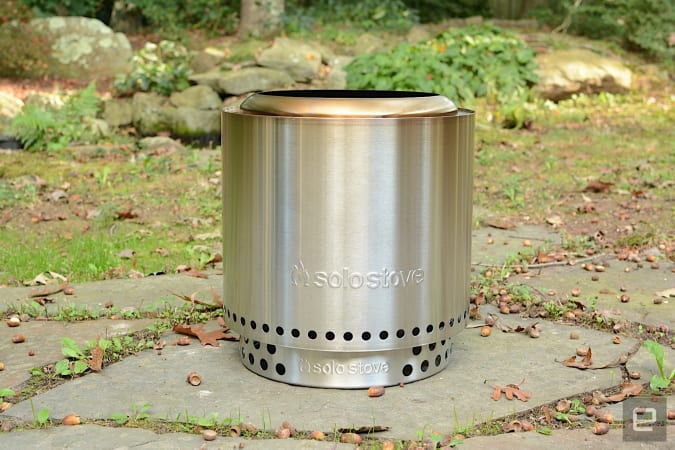
As the holiday weekend approaches, deals on the latest gadgets have been popping up across the web. Apple's 10.2-inch iPad is $30 off right now and Solo Stove, the maker of compact, stainless steel fire pits, has knocked $120 off most of its devices. We even have a few holdouts from Amazon Prime Day still available, like deals on Anker's Eufy RoboVac 11S and a two-pack Nest WiFi system. Here are the best July 4th tech deals we could find.

10.2-inch iPad

The 10.2-inch iPad remains on sale for $299, or $30 off its normal price. It's arguably the best tablet for new tablet owners and we liked its improved performance, familiar design and support for the first-generation Apple Pencil.

Buy 10.2-inch iPad at Amazon - $299

MacBook Air M1

Apple's MacBook Air M1 has dropped to $899, which is the best price we've seen it. If you're looking to upgrade your notebook, this is one of the best options for most people right now. The Air M1 earned a score of 94 from us for its incredibly fast performance, excellent keyboard and trackpad, good battery life and lack of fan noise.

Buy MacBook Air M1 at Amazon - $899

24-inch iMac M1

Apple's colorful iMacs with 8-core GPUs are $50 off right now at Amazon, bringing them down to $1,450. We gave this desktop a score of 89 for its remarkable performance thanks to the M1 chip, lovely 24-inch Retina Display and its thin-and-light design.

Buy 24-inch iMac at Amazon - $1,450

Solo Stove Bonfire

Solo Stove

Engadget

Solo Stove's Bonfire is $120 off for the company's July 4th sale, bringing it down to $230. That's the best price we've seen, and the other models are also $120 off for a limited time, too. These are smokeless, portable fire pits that we've recommended in the past as an easy way to upgrade your backyard setup.

Buy Bonfire at Solo Stove - $230

ThermoWorks Thermapen Mk4

ThermoWorks Thermapen Mk4

Engadget

On the heels of the new Thermapen One announcement, the Thermapen Mk4 has been discounted to $69. It's the best instant-read thermometer we've used so far —the backlit display makes it easy to read in almost any situation and the display rotates depending on how you're holding the pen. Plus, you never have to remember to turn it off because the pen automatically turns on when you pick it up and will shut off after some time of no use.

ThermoWorks is also running an Independence Day sale that knocks up to 20 percent off remote BBQ alarm thermometers.

Buy Thermapen Mk4 at ThermoWorks - $69 Shop ThermoWorks Independence Day sale

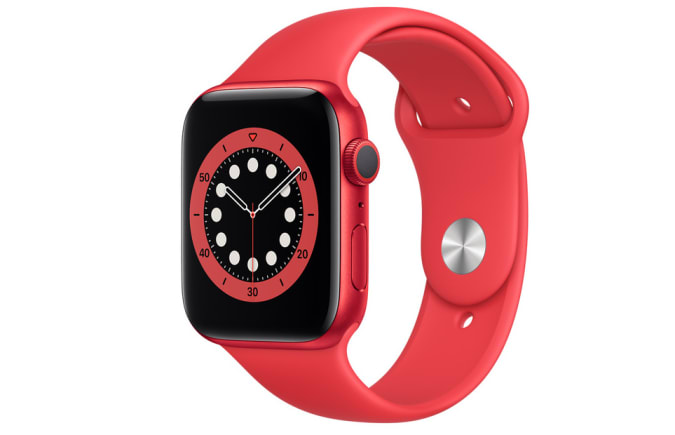
Apple Watch Series 6 Product Red Edition

Apple Watch Series 6

Apple

The GPS + Cellular models of the Apple Watch Series 6 Product Red Edition are $100 off at Amazon. The 40mm is down to $399, or close to a record low, while the 44mm version has hit an all-time low of $429. We gave the Series 6 a score of 89 for its speedier performance, quicker charging and slightly improved battery life.

Buy Apple Watch Series 6 (40mm, GPS + Cellular) at Amazon - $399 Buy Apple Watch Series 6 (44mm, GPS + Cellular) at Amazon - $429

GameStop Independence Day sale

Ubisoft / Nintendo

Through Sunday, July 4, GameStop is running a holiday sale that includes a "buy two, get one free" promo on a number of titles including Marios + Rabbids Kingdom Battle and Spider-Man: Miles Morales. The sale also includes discounts on pre-owned games as well as $30 in extra credit when you trade in a PS4, XB1, Nintendo Switch or another console.

Shop GameStop's Independence Day sale

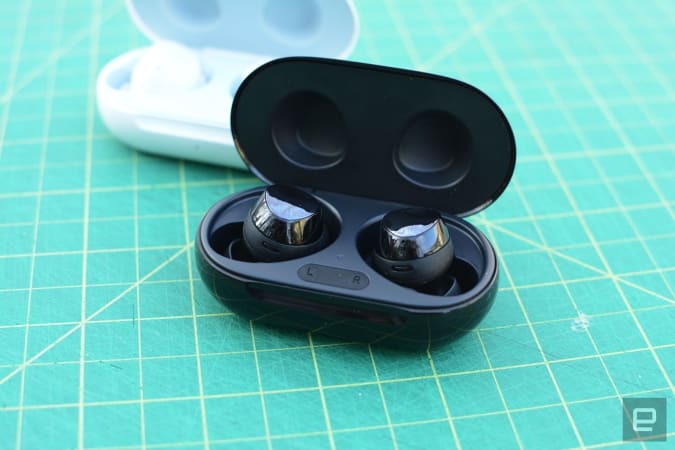
Samsung Galaxy Buds+

Samsung Galaxy Buds+

Billy Steele / Engadget

Both Amazon and Microsoft have the Galaxy Buds+ for $100, or $50 off their normal price. We gave them a score of 83 for their improved audio quality, longer battery life, deeper iOS integration and better call quality.

Buy Galaxy Buds+ at Amazon - $100 Buy Galaxy Buds+ at Microsoft - $100

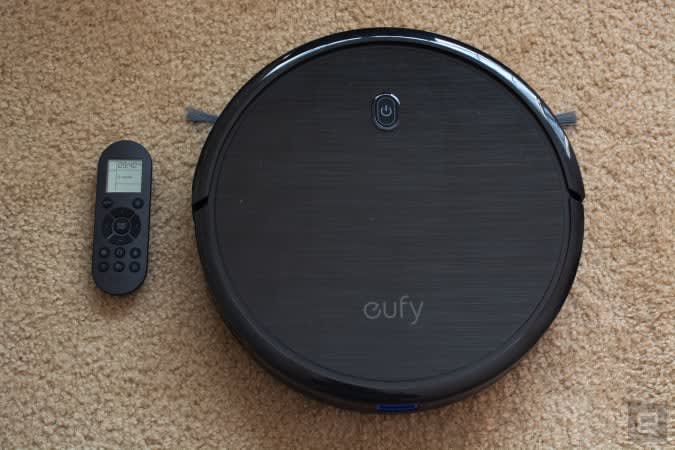
Anker Eufy RoboVac 11S

One of our favorite budget robot vacuums, the Anker Eufy RoboVac 11S, has dropped to $140. That's $90 off its normal price and close to its record-low. Not only is this one of the slimmest robo-vacs we've tried, but it cleans hard floors and carpets thoroughly and it comes with a remote that you can use to manually direct the vacuum, set schedules and more.

Buy RoboVac 11S at Amazon - $140

Google Nest WiFi (2 pack)

The Nest WiFi pack with one router and one extension point is down to $189, or $80 off. We gave this mesh system a score of 84 for its unobtrusive design, simple installation process and built-in smart speaker capabilities.

Buy Nest WiFi (2 pack) at Walmart - $189

55-inch LG C1 OLED 4K smart TV

LG's 2021 C1 OLED 4K TVs have dropped in price, so you can grab the 55-inch for $1,497, or about $300 off its normal price. The C1 is the mid-tier lineup that includes the company's latest processor, HDMI 2.1 support and NVIDIA G-SYNC and FreeSync compatibility.

Buy 55-inch LG C1 OLED at Amazon - $1,497 Buy 55-inch LG C1 OLED at Best Buy - $1,500

48-inch LG CX OLED 4K smart TV

My Best Buy members can get the 48-inch LG CX OLED 4K smart TV for $1,250, or $250 off its normal price. It's free to sign up for My Best Buy and it's worth it to get a bit of extra money off all of the retailer's current sales. This OLED set has LG's a9 Gen 3 processor, support for Dolby Vision, Atmos, HDR10 and HLG plus Google Assistant and Amazon Alexa integration.

Buy 48-inch LG CX OLED at Best Buy - $1,250

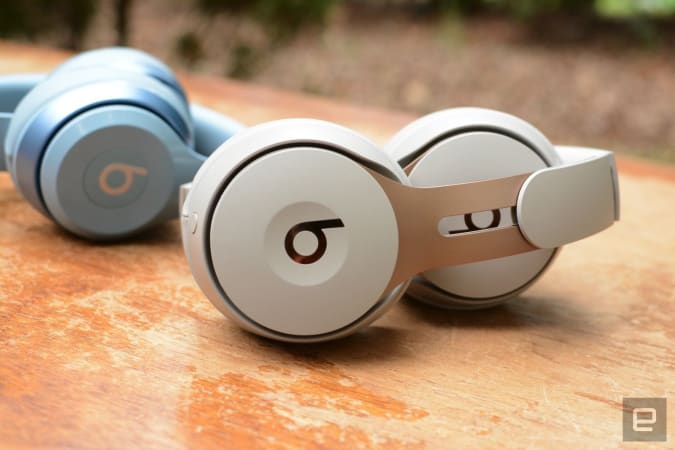
Beats Solo Pro

The Beats Solo Pro are still discounted to a record-low of $149. We liked these on-ear cans for their excellent sound quality, good ANC and hands-free Siri capabilities.

Buy Beats Solo Pro at Walmart - $149

Omaze gaming PC giveaway

An african guy talks on a video link with his friends in a computer club.

fpphotobank via Getty Images

Omaze is giving away another $20,000 to build your ultimate gaming PC. This sweepstakes is free to enter, but funds donated with purchased entries will benefit Schools on Wheels, an organization that provides free tutoring and mentoring services to children experiencing homelessness across Southern California. Through July 2, you can use the code RADNESS150 at checkout to get an additional 150 bonus entries.

Enter to win at Omaze

Pricing and availability is subject to change. No donation or payment necessary to enter or win this sweepstakes. See official rules on Omaze.

New tech deals

55-inch Sony A8H Bravia OLED smart TV

Amazon knocked about $600 off Sony's 55-inch A8H Bravia OLED smart TV. It includes the company's X1 Ultimate processor, Game Mode for a smoother, more responsive experience, the Android TV operating system and support for the Google Assistant, Amazon's Alexa and even Apple's AirPlay 2.

Buy 55-inch Sony A8H Bravia OLED at Amazon - $1,298

MagSafe charger

Apple's MagSafe charger is down to $34 at Amazon, or $6 off its normal price. While not a huge discount, it's a good opportunity to get a first-party accessory for less. This thin disk magnetically attaches to the back of the latest iPhones to power them up.

Buy MagSage charger at Amazon - $34

Twelve South 4th of July sale

The accessory maker Twelve South is running a 4th of July sale through July 5th that knocks up to 60 percent off of many products. Of note are the AirFly Bluetooth transmitter for as low as $25, the Compass Pro adjustable iPad stand for $50 and the HiRise Lightning Stand for $25.

Shop Twelve South 4th of July sale

Casetify July 4th sale

Casetify's holiday sale gets you 15 percent off most items through July 5th when you use the code 4JULY21 at checkout. The company makes colorful cases and protective gear for numerous mobile devices including iPhones, Galaxy handsets, AirPods and more. They also make great gifts thanks to Casetify's extensive library of customizable accessories.

Shop Casetify's July 4th sale

Speck Independence Day sale

Through July 4th, you can get 30 percent off sitewide at Speck. In addition to iPhones and Android device cases, Speck has gear for AirPods, MacBooks, Kindles, Chromebooks and others. If you want a case for your smartphone that will both look good and keep your gadget safe, Speck accessories are good options.

Shop Speck's Independence Day sale

Aukey PowerZeus 500 portable power station

Aukey's PowerZeus 500 portable power station is on sale for $367 when you use the code AUKEYPLUS at checkout. This 518Wh station can easily come with you on a camping trip to provide juice to all your devices, or act as a backup battery during power outages.

Buy PowerZeus 500 at Aukey - $367

NordVPN

One of our recommended VPNs is running a good sale on a two-year subscription. You can sign up for NordVPN for only $89 for the first two years, which comes out to $44.50 per year. We like NordVPN for its speed, its no-logs policy, the thousands of servers it has to choose from and that one account supports up to six connected devices.

Sign up for NordVPN (two years) - $89

Follow @EngadgetDeals on Twitter for the latest tech deals and buying advice.

Adblock test (Why?)


The best July 4th tech deals we could find - Engadget
Read More

iOS 15 public beta is here, but is your iPhone compatible? Check this list - CNET

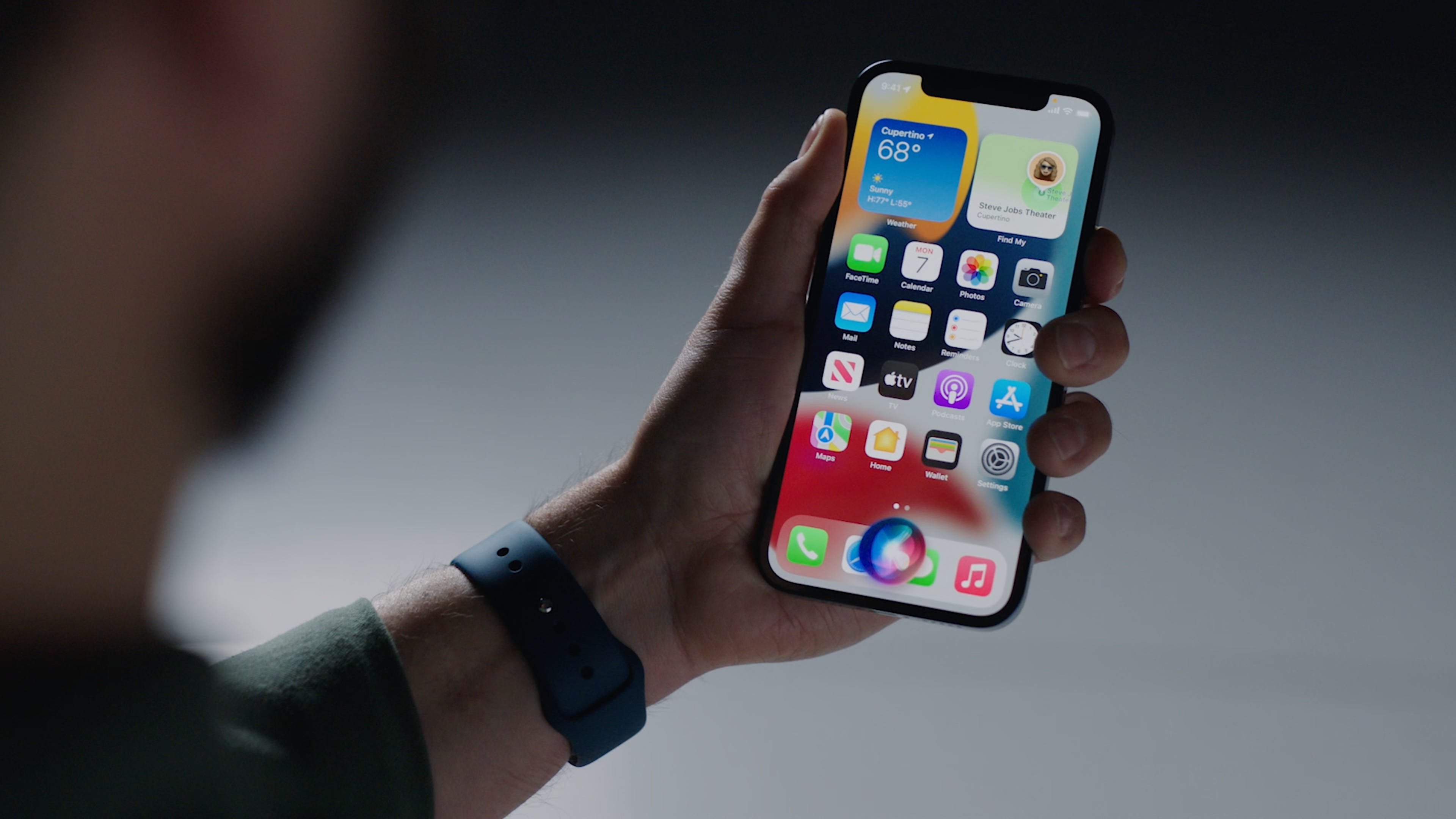
wwdc-2021-apple-305privacy-features.png

iOS 15 is compatible with the iPhone 6S and later. 

Apple/Screenshot by Sarah Tew/CNET
This story is part of Apple Event, our full coverage of the latest news from Apple headquarters.

The next major software update for the iPhone, iOS 15, is now available for those who want to test it. Unveiled at Apple's Worldwide Developers Conference along with a slate of other product releases in June, iOS 15 is now available as a public beta (here's how to download iOS 15), with the general release arriving in the fall, likely alongside the rumored iPhone 13. 

iOS 15 includes new features like the ability to start FaceTime calls with Android users, easier sharing on iMessage and updates to Apple Maps. In terms of privacy-focused improvements, iOS 15 expands on-device processing to further limit the potential circulation of your data, and gives you more information about what data third-party apps are collecting from your Apple devices. 

Want to know if you'll be able to download iOS 15 on your iPhone once it's generally available? Here are all of the supported devices.

Will iOS 15 work on my iPhone? 

iOS 15 will be compatible with the following iPhones, according to Apple:

  • iPhone 12
  • iPhone 12 Mini
  • iPhone 12 Pro
  • iPhone 12 Pro Max
  • iPhone 11
  • iPhone 11 Pro
  • iPhone 11 Pro Max
  • iPhone XS
  • iPhone XS Max
  • iPhone XR
  • iPhone X
  • iPhone 8
  • iPhone 8 Plus
  • iPhone 7
  • iPhone 7 Plus
  • iPhone 6S
  • iPhone 6S Plus
  • iPhone SE (first and second generation)
  • iPod Touch (seventh generation) 

For more, check out everything we know about iOS 15, how to download iOS 15, and how to go back to iOS 14. 

Now playing: Watch this: We found these amazing features in the iOS 15 beta

17:38

Adblock test (Why?)


iOS 15 public beta is here, but is your iPhone compatible? Check this list - CNET
Read More

Twitter considers new features for tweeting only to friends, under different personas and more - TechCrunch

Twitter has a history of sharing feature and design ideas it’s considering at very early stages of development. Earlier this month, for example, it showed off concepts around a potential “unmention” feature that would let users untag themselves from others’ tweets. Today, the company is sharing a few more of its design explorations that would allow users to better control who can see their tweets and who ends up in their replies. The new concepts include a way to tweet only to a group of trusted friends, new prompts that would ask people to reconsider the language they’re using when posting a reply, and a “personas” feature that would allow you to tweet based on your different contexts — like tweets about your work life, your hobbies and interests, and so on.

The company says it’s thinking through these concepts and is looking to now gather feedback to inform what it may later develop.

The first of the new ideas builds on work that began last year with the release of a feature that allows an original poster to choose who’s allowed to reply to their tweet. Today, users can choose to limit replies to only people mentioned in the tweet, only people they follow, or they can leave it defaulted to “everyone.” But even though this allows users to limit who can respond, everyone can see the tweet itself. And they can like, retweet or quote tweet the post.

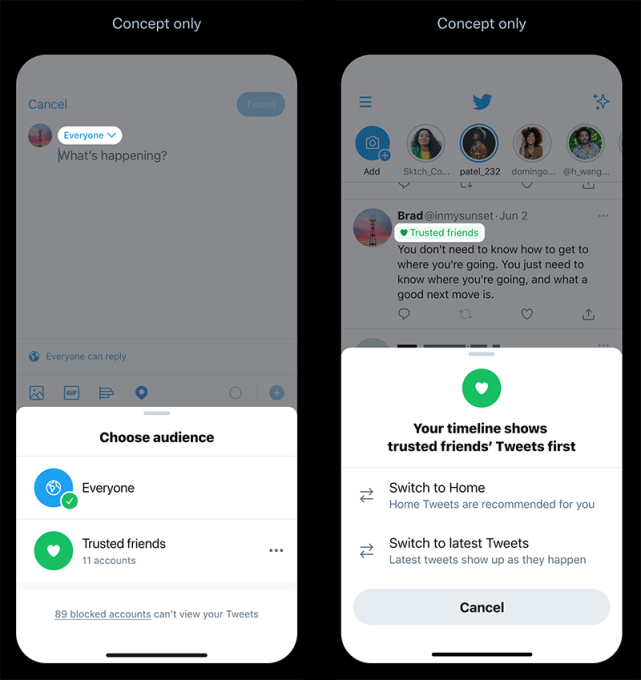
With the proposed Trusted Friends feature, users could tweet to a group of their own choosing. This could be a way to use Twitter with real-life friends, or some other small network of people you know more personally. Perhaps you could post a tweet that only your New York friends could see when you wanted to let them know you were in town. Or maybe you could post only to those who share your love of a particular TV show, sporting event or hobby.

Image Credits: Twitter

This ability to have private conversations alongside public ones could boost people’s Twitter usage and even encourage some people to try tweeting for the first time. But it also could be disruptive to Twitter, as it would chip away at the company’s original idea of a platform that’s a sort of public message board where everyone is invited into the conversation. Users may begin to think about whether their post is worthy of being shared in public and decide to hold more of their content back from the wider Twitter audience, which could impact Twitter engagement metrics. It also pushes Twitter closer to Facebook territory where only some posts are meant for the world, while more are shared with just friends.

Twitter says the benefit of this private, “friends only” format is that it could save people from the workarounds they’re currently using — like juggling multiple alt accounts or toggling between public to protected tweets.

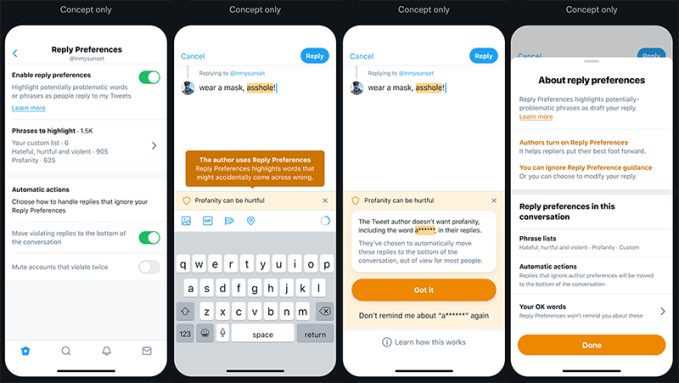
Another new feature under consideration is Reply Language Prompts. This feature would allow Twitter users to choose phrases they don’t want to see in their replies. When someone is writing back to the original poster, these words and phrases would be highlighted and a prompt would explain why the original poster doesn’t want to see that sort of language. For instance, users could configure prompts to appear if someone is using profanity in their reply.

Image Credits: Twitter

The feature wouldn’t stop the poster from tweeting their reply — it’s more a gentle nudge that asks them to be more considerate.

These “nudges” can have impact. For example, when Twitter launched a nudge that suggested users read an article before they amplify it with a retweet, it found that users opened articles before sharing them 40% more often. But in the case of someone determined to troll, it may not do that much good.

The third, and perhaps most complicated, feature is something Twitter is calling “Facets.”

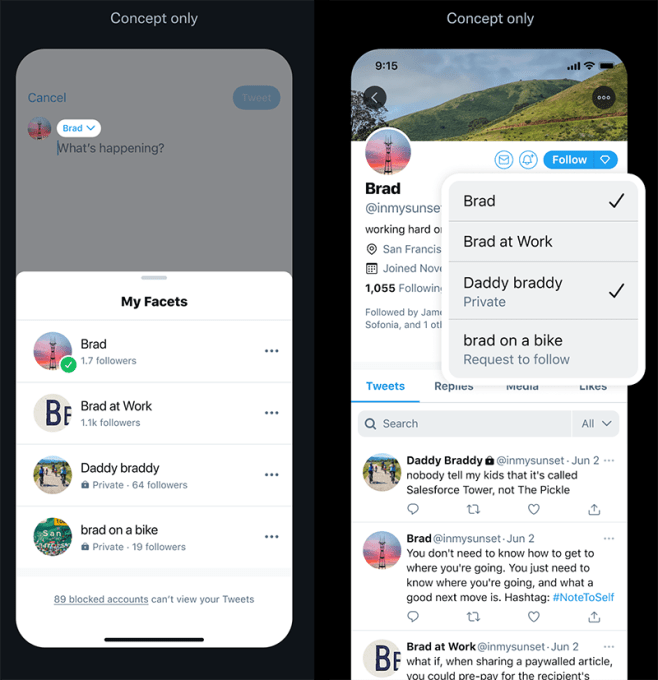
This is an early idea about tweeting from different personas from one account. The feature would make sense for those who often tweet about different aspects of their lives, including their work life, their side hustles, their personal life or family, their passions and more.

Image Credits: Twitter

Unlike Trusted Friends, which would let you restrict some tweets to a more personal network, Facets would give other users the ability to choose whether they wanted to follow all your tweets, or only those about the “facet” they’re interested in. This way, you could follow someone’s tweets about tech, but ignore their stream of reactions they post when watching their favorite team play. Or you could follow your friend’s personal tweets, but ignore their work-related content. And so on.

This is an interesting idea, as Twitter users have always worried about alienating some of their followers by posting “off-topic” so to speak. But this also puts the problem of determining what tweets to show which users on the end user themselves. Users may be better served by the algorithmic timeline that understands which content they engage with, and which they tend to ignore. (Also: “facets‽”)

Twitter says none of the three features are in the process of being built just yet. These are only design mockups that showcase ideas the company has been considering. It also hasn’t yet made the decision whether any of the three will go under development — that’s what the user feedback it’s hoping to receive will help to determine.

Adblock test (Why?)


Twitter considers new features for tweeting only to friends, under different personas and more - TechCrunch
Read More

Microsoft warns of critical Windows ‘PrintNightmare’ vulnerability - The Verge

Microsoft is warning Windows users about an unpatched critical flaw in the Windows Print Spooler service. The vulnerability, dubbed PrintNightmare, was uncovered earlier this week after security researchers accidentally published a proof-of-concept (PoC) exploit. While Microsoft hasn’t rated the vulnerability, it allows attackers to remotely execute code with system-level privileges, which is as critical and problematic as you can get in Windows.

Researchers at Sangfor published the PoC, in what appears to have been a mistake, or a miscommunication between the researchers and Microsoft. The test code was quickly deleted, but not before it had already been forked on GitHub.

Sangfor researchers had been planning to detail multiple 0-day vulnerabilities in the Windows Print Spooler service at the annual Black Hat security conference later this month. It appears the researchers thought Microsoft had patched this particular vulnerability, after the company published patches for a separate Windows Print Spooler flaw.

It has taken Microsoft a couple of days to finally issue an alert about the 0-day, and Bleepingcomputer reports that the company is even warning customers that it’s being actively exploited. The vulnerability allows attackers to use remote code execution, so bad actors could potentially install programs, modify data, and create new accounts with full admin rights.

Microsoft admits “the code that contains the vulnerability is in all versions of Windows,” but it’s not clear if it’s exploitable beyond server versions of Windows. The Print Spooler service runs by default on Windows, including on client versions of the OS, Domain Controllers, and many Windows Server instances, too.

Microsoft is working on a patch, but until it’s available the company recommends disabling the Windows Print Spooler service (if that’s an option for businesses), or disabling inbound remote printing through Group Policy. The Cybersecurity and Infrastructure Security Agency (CISA) has recommended that admins “disable the Windows Print Spooler service in Domain Controllers and systems that do not print.”

Vulnerabilities in the Windows Print Spooler service have been a headache for system administrators for years. The most infamous example was the Stuxnet virus. Stuxnet used multiple 0-day exploits, including a Windows Print Spooler flaw, to destroy several Iranian nuclear centrifuges more than a decade ago.

Adblock test (Why?)


Microsoft warns of critical Windows ‘PrintNightmare’ vulnerability - The Verge
Read More

PrintNightmare: Kicking users from Pre-Windows 2000 legacy group may thwart domain controller exploitation - The Register

Another potential mitigation has emerged for the PrintNightmare zero-day vuln, which lets low-privileged users execute code as SYSTEM on Windows domain controllers: remove those people from a backwards-compatibility group.

The zero-day hole came to light earlier this week after an infosec research firm mistakenly published proof-of-concept exploit code for a remote-code execution (RCE) vuln it had nicknamed PrintNightmare. Sangfor Technologies published the exploit for the vulnerability after wrongly believing Microsoft had patched it this month, having read the June Patch Tuesday notes for a remote-code execution vuln in Windows Print Spooler tracked as CVE-2021-1675.

While the patch for CVE-2021-1675 also protects against PrintNightmare on most Windows devices, it didn’t do so for domain controllers, which caused some puzzlement among security researchers. Until today, when Yunhai Zhang of Tianji Lab discovered a potential cause:

The Pre-Windows 2000 Compatible Access Group exists for backwards compatibility with Windows NT boxes and appears to be populated with authenticated users by default in new Windows Server deployments. As Windows Server blogger Dion Mosley explained: “Members of this group have Read access for viewing all users and groups within the domain. Depending on the security settings chosen during the installation of Active Directory, the Everyone group might be a member of this group.”

Mimikatz maintainer Benjamin Delpy confirmed Zhang’s findings to The Register, saying: "I can confirm that if we remove ‘authenticated users’ from this group (leaving it empty after), it stops the exploit." In short, membership of that group is an ingredient of the PrintNightmare exploit mechanism, and knowing that could at least help infosec and sysadmin folks better understand the underlying software bug. Delpy also tweeted a GIF showing the mitigation in action:

At the time of writing it is not clear what side effects removing “everyone” from the Pre-Windows 2000 Compatible Access Group will have. It may be wise to wait and see before dashing in and potentially causing problems elsewhere on your domain.

Infosec researcher Dirk-Jan Mollema tweeted: “Before you all go apply this I'd wait for some people who've actually worked with this and can tell the potential impact though.”

Meanwhile, the US government's Cybersecurity and Infrastructure Agency recommends disabling the Windows Print spooler service in domain controllers and hosts that do not print.

Microsoft still hasn’t responded to The Register’s questions about the vuln nor has it said that a patch is being worked on.

Sangfor Technologies researchers published the zero-day proof-of-concept exploit as part of a blog post discussing a vuln they had found in Windows’ print spool service. Wrongly believing that a very closely related and recently patched flaw (CVE-2021-1675) was the same as their zero-day, they dropped the code in public.

Despite their trying to retract it a day later, the PrintNightmare exploit had, by that point, been forked and cached just about everywhere, as we reported.

The exploit itself allows a low-privileged user on an Active Directory domain to use Windows’ Print Spooler service to run code as SYSTEM on vulnerable hosts. Anyone who obtains ordinary user credentials for a device on that network could potentially run malicious code on the domain controller, compromising the whole domain in one go. That is a very bad thing. ®

Adblock test (Why?)


PrintNightmare: Kicking users from Pre-Windows 2000 legacy group may thwart domain controller exploitation - The Register
Read More

Humble Bundle will start capping charitable donations in mid-July - The Verge

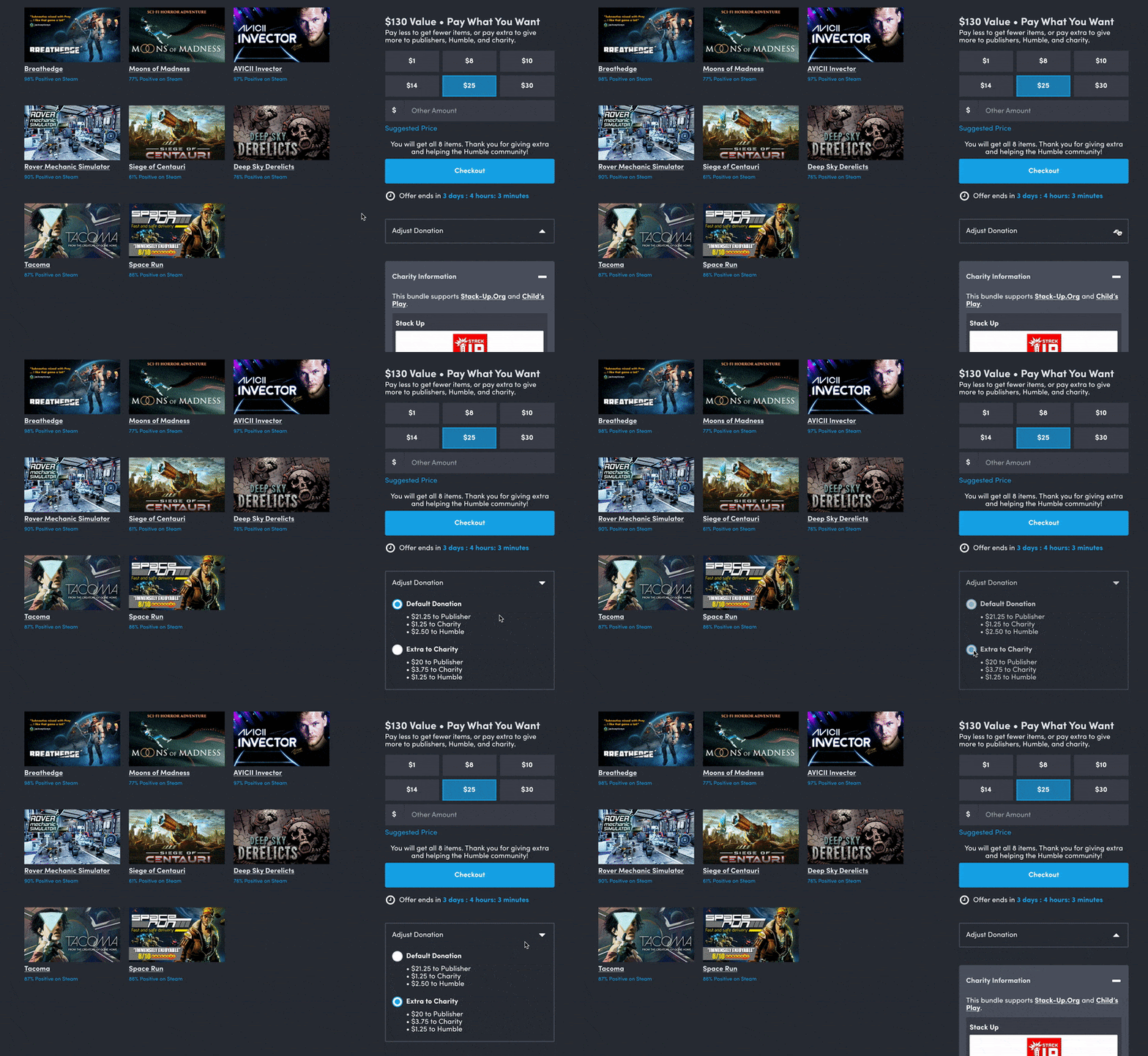
Humble Bundle has announced that it’s going to change how payment sliders will work in its storefront by removing the ability to donate all of what you spend to charity and setting an average minimum cut for Humble Bundle itself between 15 to 30 percent (via Kotaku). The change goes into effect in “mid-July.”

When you buy a bundle of games, ebooks, or software on Humble Bundle, you’re traditionally given the option to choose how much of your money goes to Humble Bundle, the creator of what you’re buying, and a charity via a slider for each. Those sliders are sticking around, but now they’ll have a bit less range.

The company justified the change in a blog post announcing its plans:

Why change after ten years? The PC storefront landscape has changed significantly since we first launched bundles in 2010, and we have to continue to evolve with it to stay on mission. The update will allow us to continue to offer great prices on amazing games, books and software all while supporting important charitable initiatives with every single purchase.

Humble Bundle first committed to changing how payments would work in April, announcing it would eliminate sliders completely, cap donations to charity at 15 percent, and introduce a series of toggles “with defined splits that clearly show what amount of your purchase will support Humble, publishers, and charity.” Users were critical of the idea of shrinking donations while Humble Bundle would have been guaranteed to get a piece of every purchase, and the company ultimately rolled back its planned changes and announced it would explore other ways to improve upon payments. Thursday’s news is the company’s alternative.

Humble Bundle became well-known for its flexible pay-what-you-want bundles. The original form of sliders allowed a customer to kick more of their money towards the developer or a charity, including reducing Humble Bundle’s cut to zero in favor of the other two. Humble said going forward after its planned change, splits will vary on bundles, but it expects to take a cut somewhere between 15 to 30 percent.

It makes sense that the cost of getting games to participate in bundles would have gone up, with some storefront’s like the Epic Games Store writing checks to give away exclusive games for free, but it is disappointing that Humble Bundle has backed away somewhat from the more altruistic model it made its name on.

As someone who’s used Humble Bundle to buy games in the past, I wasn’t as attached to sliders as I was the flexibility they represented — the idea that if I wanted to, I could know all of my money was going to the people who might need it most. Other stores like Itch.io allow you to send more money to developers directly, but Humble Bundle’s setup was unique. Come mid-July, it’ll just be a little less flexible.

Adblock test (Why?)


Humble Bundle will start capping charitable donations in mid-July - The Verge
Read More

Google's encryption-breaking Magic Compose AI proves iPhone shouldn't support RCS messaging - BGR

For years, Google has been dying to come up with an iMessage equivalent, a key iPhone feature that’s probably responsible for stealing plent...