If you still have a device running Android 2.3.7 (the final version of Gingerbread) or older, Google won’t let you sign in to your Google account on that device starting September 27th, according to a support document (via Liliputing).
“As part of our ongoing efforts to keep our users safe, Google will no longer allow sign-in on Android devices that run Android 2.3.7 or lower starting September 27, 2021,” the company says. “If you sign into your device after September 27, you may get username or password errors when you try to use Google products and services like Gmail, YouTube, and Maps.”
To give you an idea of just how old a device will be affected by this change, Android 2.3.7 was released nearly 10 years ago. But given that there are more than three billion active Android devices in the wild right now, this change will likely affect more than a few people who might still be holding on to older tech.
If you’re on Android 2.3.7 or older after that September 27th deadline, you’ll still be able to use some Google services if you’re logged in on your device’s browser, according to Google. But devices on Android 3.0 (Honeycomb) will continue to be able to log in to Google accounts, the company says, so if your older device can be updated, you might want to do that.
Last week, Apple released the MagSafe Battery Pack which, next to the MagSafe wallet, is one of my favorite accessories for the iPhone 12 family. When the iPhone 12 launched in October, MagSafe charging was the most surprising and curious addition. Apple took Qi wireless charging, which is used by current iPhone models and most Android phones, and added magnets. MagSafe ensures that your iPhone 12 is perfectly positioned to charge as efficiently as possible. It also allows for a number of new accessories like wallets, tripod mounts and PopSockets.
The MagSafe Battery Pack costs $99 (£99, AU$139). That's double the price of other magnetic battery packs from third-party companies like Anker and Mophie. Apple does add a neat bit of iOS integration, like the ability to monitor how much battery charge the MagSafe Battery Pack has from the iOS battery widget.
My biggest criticism is that I wished it had been available when the iPhone 12 launched. As a proud iPhone 12 Mini owner, it gives me that extra push to make it through a full day instead of needing to charge it in the late afternoon. And I have friends who really wanted to buy a 12 Mini, but were worried about how they'd cope with a shorter battery life and got the base iPhone 12 instead. I could see several getting a 12 Mini and a MagSafe Battery Pack -- and being very content.
Similarly, I can see people at an Apple Store buying a new iPhone 12, or the heavily rumored iPhone 13, and grabbing a MagSafe Battery Pack off the shelf. If you're looking for something that can double as a charging pad and an on-the-go wireless battery pack t, the MagSafe Battery Pack is a solid option. But if you are willing to part with some of Apple's built-in niceties, there are third-party options that are a better value.
I used the MagSafe Battery Pack for five days, and here's everything you need to know.
The battery pack is the latest addition to Apple's MagSafe accessory line.
Patrick Holland/CNET
How does the MagSafe Battery Pack charge an iPhone?
It starts charging when you slap it on the back of an iPhone. There isn't a button to press. It charges the phone at 5 watts, which is equivalent to using an old Apple USB-A charger.
When plugged in, the MagSafe Battery Pack supports pass-through charging at a faster 15 watts. You need to use a 20-watt wall charger, which costs an additional $19 on top of the $99 price of the pack.
What iPhone models does the MagSafe Battery Pack work with?
For full-functionality, you need an iPhone 12, 12 Mini, 12 Pro or 12 Pro Max. If you have an iPhone with wireless charging you can use the MagSafe Battery Pack as a Qi wireless charging pad. You just can't stick it on the back.
The following iPhone models support wireless charging:
iPhone 12 Pro
iPhone 12 Pro Max
iPhone 12 Mini
iPhone 12
iPhone 11 Pro
iPhone 11 Pro Max
iPhone 11
iPhone SE (2020)
iPhone XS
iPhone XS Max
iPhone XR
iPhone X
iPhone 8
iPhone 8 Plus
How much does the MagSafe Battery Pack cost?
It costs $99. But if you want to get the most out of it, especially for pass-through charging, you need a 20-watt wall charger (which Apple sells for $19). This puts the price closer to $120.
One of the several iOS integrations for the MagSafe Battery Pack is the ability to show the remaining battery percentage of the pack in the iPhone's battery widget.
Patrick Holland/CNET
What does the MagSafe Battery Pack come with?
The battery pack and documentation are in the box. That's it. You don't get a Lightning-to-USB-C cable or a wall charger.
Is there a MagSafe Battery Pack phone case?
No. Some people hoped Apple would release a battery case as it had in years past. But the MagSafe Battery Pack is actually more versatile because you can use it as an on-the-go wireless battery pack or plug it into a wall as a MagSafe charging pad. Since it's not a case that's semi-permanently living on your phone, you can also use it to charge other Qi wireless phones and accessories.
What else can I charge with the MagSafe Battery Pack?
You can use it to charge your AirPods or AirPods Pro case, wireless iPhone models and Android phones that support Qi charging. It just won't charge them very quickly.
The battery pack has excellent iOS integration, like showing the pack's battery percentage in the iOS battery widget. Your iPhone automatically shuts off charging once the device is at 90%. This helps prolong the life of your iPhone's battery. If you want to charge past that, just enable Low Power mode from the Control Panel and long-press the icon.
The MagSafe Battery Pack has a lightning port and an LED indicator.
Patrick Holland/CNET
Can you charge the MagSafe Battery Pack with an iPhone 12?
Yes. When your iPhone 12, 12 Mini, 12 Pro or 12 Pro Max are plugged into power and the MagSafe Battery Pack is attached, it will charge both the phone and the pack. When I tried this, my iPhone 12 Mini charged to 80% first, then the MagSafe Battery Pack started charging.
How much will the MagSafe Battery Pack charge my iPhone?
I tested it with several models of the iPhone 12 family. I attached a fully charged MagSafe Battery Pack to each iPhone 12 version, all of which had an empty battery. Here is roughly what you can expect it to charge:
iPhone 12 Mini to 80%
iPhone 12 and 12 Pro to 60%
iPhone 12 Pro Max to 50%
Is it true that you can't charge an iPhone past 90%?
Yes and no. To protect the longevity of your phone's battery, the MagSafe Battery Pack will stop charging your iPhone when it hits 90%. You can easily override this by putting your iPhone into Low Power mode and long-pressing on the Low Power icon in the Control Panel.
What colors does the MagSafe Battery Pack come in?
It's only available in white. Different colors would be nice and would, especially at a time when you can buy a yellow iMac.
What does the MagSafe Battery Charger look like on different models of the iPhone 12 family?
It's perfectly flush with the sides and bottom of the iPhone 12 Mini. Otherwise, there is a small gap between it and the sides of other models. It's roughly the height and width of the MagSafe wallet. Here's what it looks like on each iPhone 12 model:
The Apple MagSafe Battery Pack on the iPhone 12 Mini.
Patrick Holland/CNET
The Apple MagSafe Battery Pack on the iPhone 12.
Patrick Holland/CNET
The Apple MagSafe Battery Pack on the iPhone 12 Pro.
Patrick Holland/CNET
The Apple MagSafe Battery Pack on the iPhone 12 Pro Max.
Patrick Holland/CNET
How heavy is the MagSafe Battery Pack?
At 115 grams (a little over 4 ounces), it's solid and a tad hefty. It feels fine on the iPhone 12 Mini and 12: I started to notice the weight when I had it on the iPhone 12 Pro. If you have it on the iPhone 12 Pro Max, it is very heavy: The combo weighed just over 342 grams (12 ounces).
What is the capacity of the MagSafe Battery Pack?
The MagSafe Battery Pack has a capacity of 1,460 mAh (11.13Wh).
All of Apple's MagSafe chargers and accessories for the iPhone 12
August has arrived and, with it, the countdown to Samsung’s next Unpacked event where we’ll see the debut of new foldables, earbuds, and the company’s first Wear OS smartwatches in years. This weekend, the first live images of the Galaxy Watch 4 Classic have hit the web, showing off both colors and a peek at the Wear OS UI.
Max Weinbach and 91Mobiles both obtained and published live images, the former having more images to share, of different Galaxy Watch 4 Classic variants. One is the black model, the other a polished silver version. Both appear to use the same stainless steel construction as past Galaxy Watch models with rotating bezels. Two physical buttons are also clearly visible, along with white and black bands that appear to be leather, though presumably a faux material.
As other leaks have shown, there is a physical bezel around the watch with numbers around the face to imitate the look of a classic analog timepiece. In the middle, though, is, of course, a touchscreen that appears to have almost no additional bezel beyond those numbers.
The screen is on in both images, but there’s not a ton to gather from what’s displayed. There’s clear design inspiration from One UI on Galaxy smartphones, but not much obvious coming from Google’s Wear OS.
Weinbach also went on to share two images showing off the app drawer to One UI Watch and one of Samsung’s built-in watchfaces.
Samsung will officially launch the Galaxy Watch 4 Classic and the Galaxy Watch 4 in just under two weeks on August 11. The pair of smartwatches will also launch Wear OS 3.
More on Samsung:
This article was updated after publication to include images posted by Max Weinbach.
We’re a little over a week away from Samsung’s next Unpacked event, but new photos from 91mobiles may have revealed our first in-person look at two things we could see at the show: the rumored Galaxy Watch 4 Classic and the new smartwatch OS from Samsung and Google.
The two photos from 91moblies show off black and silver watches with rounded bezels, matching a design seen in leaked renders from Android Headlines and detailed GIFs posted by noted leaker Evan Blass in July. Perhaps more significantly, the photos show the new smartwatch OS (currently referred to as Wear) on actual devices for the first time. But disappointingly, there isn’t much to see — just an initial setup screen and a screen asking the user to set the time.
Google and Samsung announced they would be essentially merging Wear OS and Tizen at Google I/O in May, promising improvements to battery life, faster app loading times, and other more. And in May, Samsung gave us an idea of what the new OS will look like on its devices (and it looks great in what the company showed, if you ask me).
While Samsung’s teases for August 11th’s Unpacked hint strongly toward new foldables, the company has revealed new smartwatches at previous AugustUnpacked events, so it’s possible we could see a new smartwatch next week. And based on other recent leaks, Samsung may announce another smartwatch as well, the Watch Active 4.
Forget Google Search and Fuchsia. Researchers from Google, Stanford, Princeton, and other universities might have made a computer discovery so big we can’t fully comprehend it yet. Even Google researchers aren’t entirely sure that their time crystal discovery is valid. But if it turns out to be accurate, then Google might be one of the first companies to give the world a crucial technological advancement for the future. Time crystals will be an essential building block in quantum computers, the kind of computers that can solve complex problems with incredible speed and power technologies that aren’t even invented.
As The Next Web explains, we plan on using quantum computers for challenging problems. Examples include warp drives that could make fast interstellar travel possible. And medical technology that could cure virtually any disease.
Google partnered with Michael Peña for a quantum computing demo at I/O 2021 earlier this year:
But quantum computers are really hard to build, maintain, and even use. That’s where Google’s time crystals might come into play. As it stands now, quantum computers feature qubits, computer bits in the quantum world. These qubits act differently when someone observes them than when they’re left alone. That’s what makes it difficult to measure qubit states. And that instability makes using a quantum computer problematic. That’s where time crystals come in.
Google’s time crystals
Theorized in 2012, the time crystal concept is a new phase of matter. The Next Web explains that time crystals contradict one of Sir Isaac Newton’s famous laws. The first law of motion says that “an object at rest tends to stay at rest and an object in motion tends to stay in motion.”
In our universe, there’s something called high entropy (disorder). Something always happens thanks to energy exchanges. Entropy remains the same if there are no processes but increases in their presence. But that’s not valid for time crystals. They can maintain entropy even when they’re used in a process.
To understand Google’s time crystals, The Next Web offers a great analogy with snowflakes. They have unique designs, as the atoms are arranged in specific ways. Snow falls, melts, water evaporates, and then it’ll eventually become snow again. All these processes involve energy exchanges. A time crystal would be like having a snowflake that can change between two configurations back and forth with no energy usage or energy loss. Time crystals can have their cake and eat it too, and they can do it perpetually.
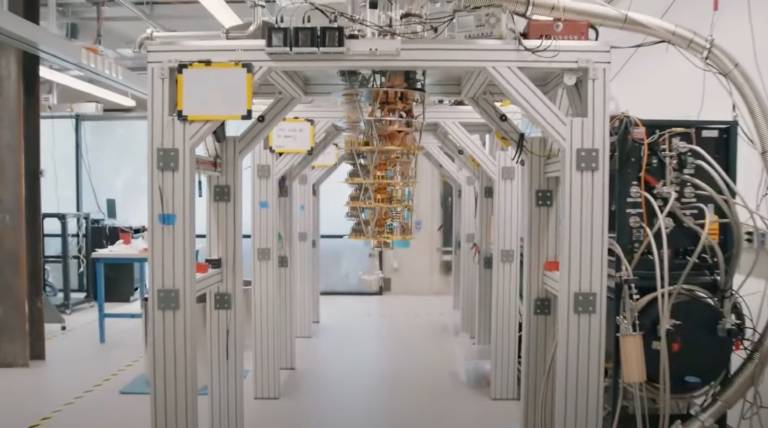
Inside a Google quantum computer. Image source: Google
What does it mean for you and me?
Google’s time crystals do not belong to Google. Even the Google team doesn’t know for sure that it has created them. The research is only available in a pre-print version as it awaits validation from peers.
But if Google did find a way to make them, then next-gen quantum computers might come with time crystals inside. Anyone might be able to create these computers. And they’d bring quantum coherence to a place where there’s a lot of decoherence — those restless qubits from before.
Even so, we’re still in the super early stages of creating quantum computers with time crystals. Google might have proved that time crystals aren’t just theoretical, but it certainly hasn’t created any.
We might need decades of quantum computing research to create quantum computers with time crystals in them to build warp drives or discover “universally effective cancer treatments.” And we’ll undoubtedly need decades to understand quantum computers and time crystals properly. Google’s paper is available at this link. Moreover, Quanta Magazine also has a thorough roundup of Google’s discovery, complete with an animation of a time crystal.
In a tweet on July 30, Halo Infinite campaign director Joseph Staten confirmed on Twitter that the files for the game’s technical preview contained spoilers for the campaign. Staten went on to say that “leaks like this are painful for the dev team and can ruin the experience for everyone,” and urged fans not to spread the leaks if they see them.
Despite this request, it is very likely that file sniffers will continue to explore all available Halo Infinite files and content, looking for any possible hint into the content of what will be the first new mainline Halo title since Halo 5: Guardians released in 2015. Halo Infinite had been scheduled for a 2020 release, and was expected to follow closely on the release of the new series of Xbox consoles, but has instead been delayed until Holiday 2021.
If specific spoilers have been discovered already, it seems like they are remaining obscure, and have not (yet) made the rounds on major message boards and news outlets. If anything, given the mysterious nature of Halo’s lore, a round of spoilers might do more to stoke excitement in fans than to ruin the surprises that the campaign has in store.
While the Halo Infinite development team might be stressing about the possibility of leaks and spoilers, and some are using their time online to criticize the security of the project, players participating in the multiplayer preview have mostly been very receptive to the game itself, and seem generally excited to play Halo Infinite when it does release for Xbox and PC.