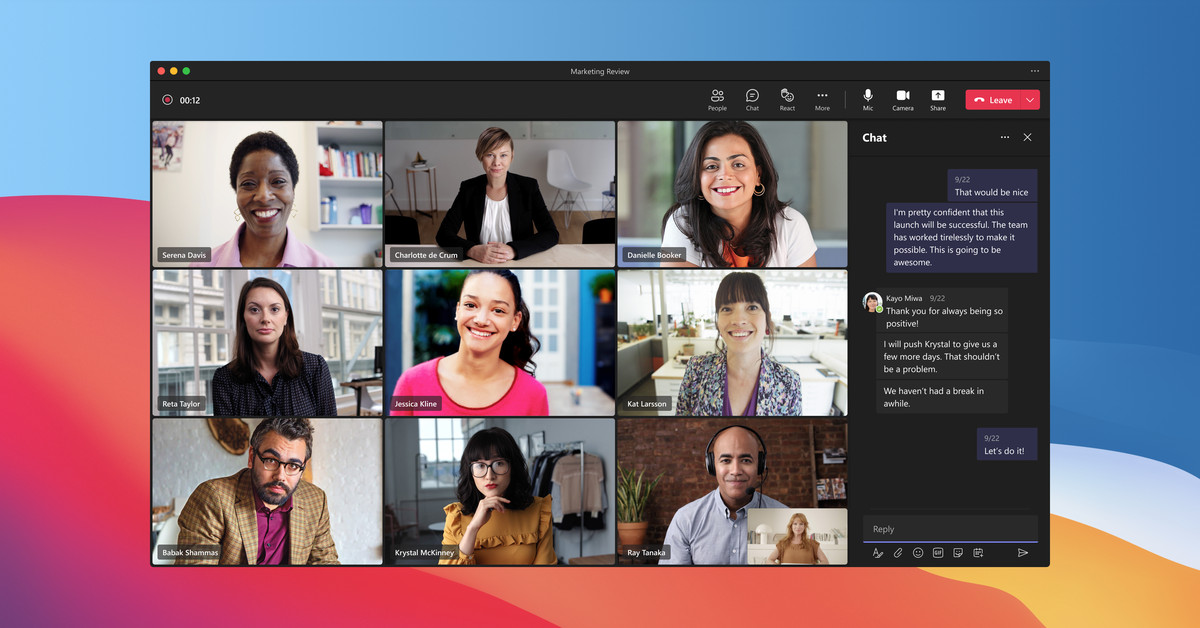
Microsoft has created a native version of its Microsoft Teams client for Macs with M1 or M2 chips. The software giant has developed a native Apple Silicon version of Microsoft Teams that should include performance benefits for Mac users with the latest M1 or M2 chips, and it’s rolling out over the coming months.
“For Mac users, this means a significant boost in performance, ensuring efficient use of device resources and an optimized Teams experience even when using multiple high-resolution monitors during calls or meetings,” says Anupam Pattnaik, a member of the Microsoft Teams product marketing team, in a blog post.
The existing version of Microsoft Teams has been running as a regular app using Apple’s Rosetta 2 emulation, and native support for Teams on Apple Silicon has been a highly requested feature. While all Mac users of Teams will eventually be automatically upgraded to this new app update, the rollout will take place over months rather than days or weeks.
“The generally available (GA) version of the native Teams app on Mac with Apple silicon is being rolled out to customers in increments over the coming months,” explains Pattnaik. If you don’t want to wait for the update to hit your machine, a beta has been available for a few months now.
The native version of Microsoft Teams for Apple Silicon comes nearly two years after Microsoft released native versions of Word, Excel, Outlook, PowerPoint, and OneNote for M1 Macs.
The best TVs I've reviewed use OLED screens, but OLED isn't the be-all, end-all in picture quality. High-end TVs with LCD-based screens can get brighter than any OLED television and come pretty close in other important areas like contrast. Samsung's QN90B is a great example, delivering searing brightness with few other compromises thanks to QLED, mini-LED and local dimming technology. It's a futuristic-sounding mouthful, but it works.
Like
Best non-OLED picture quality we've ever tested
Incredible brightness with minimal blooming
Stylish design, packed with features
Don't Like
Expensive
Slightly worse contrast, off-angle and uniformity than OLED
I compared the Samsung side-by-side with an LG OLED TV and while the LG won, the Samsung came as close as any non-OLED TV I've tested. The QN90B's ability to focus that light output with very little blooming or stray illumination produces excellent punch, contrast and overall fidelity, surpassing the performance of last year's excellent QN90A.
And as usual Samsung's design and features are top-notch. From the slick stand to the tricked-out remote to a raft of gaming extras, including a new cloud gaming hub with Xbox Game Pass compatibility, the QN90B is simply stacked. If you're in the high-end TV market and looking for an alternative to OLED, or you just have a bright room, the QN90B deserves a look.
Samsung QN90B sizes
I performed a hands-on evaluation of the 65-inch QN90B but this review also applies to the other screen sizes in the series. All sizes have similar specs and should provide similar picture quality.
The QN90B sits at the high-end of Samsung's 4K Neo QLED TV line for 2022. Its main improvement over the less-expensive QN85B is better local dimming, according to the spec sheet. Samsung does offer a more-expensive 4K model, the QN95B, but its main perk over the QN90B is a separate OneConnect box for the inputs that allows you to run a single cable to the TV. Samsung also charges more for its 8K series, but we don't think it's worth paying extra for that higher resolution. The flagship 8K QN900B has better local dimming than the QN90B and should deliver a superior picture, but it's more than twice as expensive.
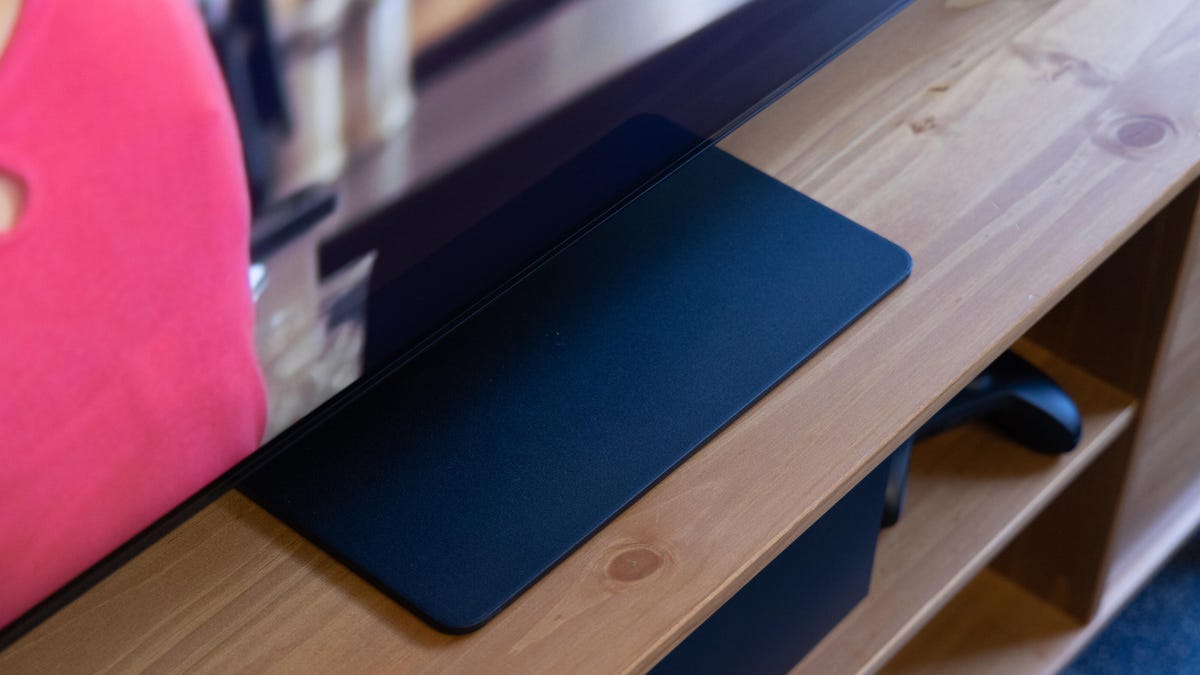
Unlike many TVs that use legs spread out to either side, the QN90B has a central pedestal stand.
Bobby Oliver/CNET
Now playing:Watch this: Samsung QLED TV Is an Ultra-Bright Gaming Powerhouse
12:43
Distinctive touches, excellent remote
On the outside the QN90B looks basically the same as last year's QN90A, and that's a good thing. Minimalist and nearly all-picture, its most distinctive feature is the stand, which Samsung's website calls a "bending plate." I'm here for that. Centered, with a small footprint, it looks cleaner and sleeker than the dual legs found on most TVs. My favorite aspect is how it suspends the big panel above my credenza, seeming to float.
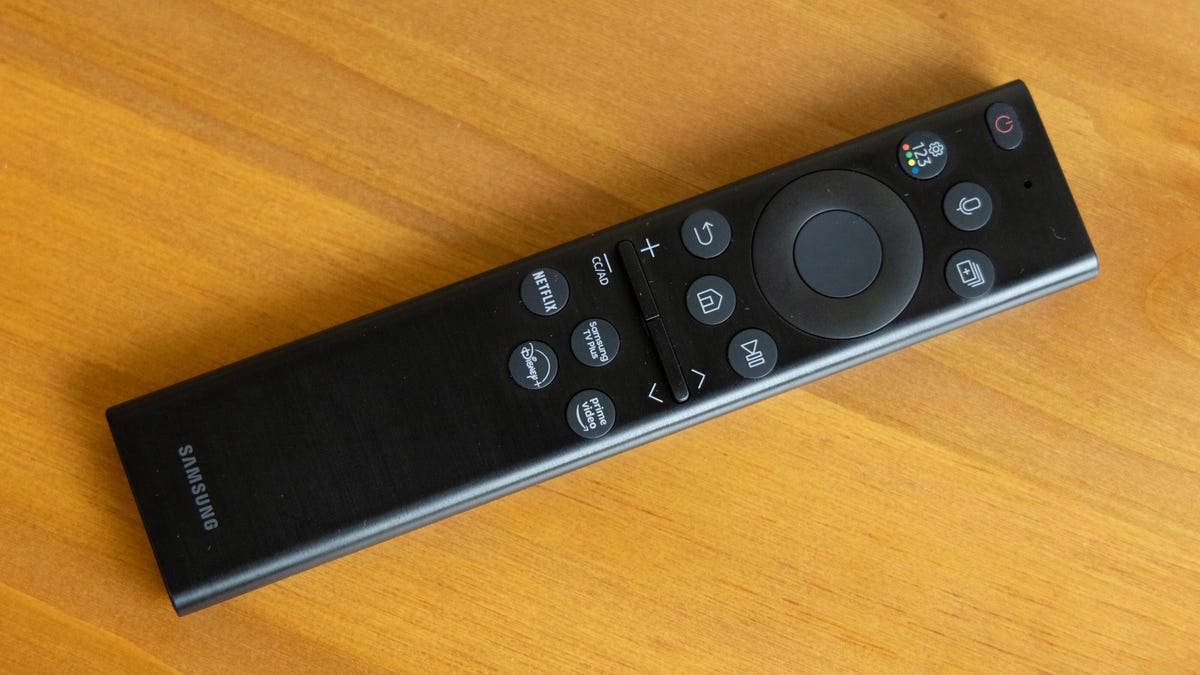
The clicker includes voice access via the mic button as well as streaming shortcuts keys.
Bobby Oliver/CNET
Samsung's sleek, rounded remote is my favorite TV clicker overall thanks to superior form and function. The keys are well-placed, pleasantly sparse and lack garish colors, the raised volume and channel bars are a nice change from standard buttons and the metallic, wraparound finish feels high-end. I love that it's rechargeable rather than reliant on batteries, and you can top it off via USB-C, the solar cell on the back or RF harvesting. I didn't test the latter two methods.
Cluttered menu, cool cloud gaming
I went through my complaints with Samsung's new 2022 TV menu design in my Q60B review so I'll mention them only briefly here. Too much screen real estate is wasted with ads, clutter and items I don't care about, while many useful functions are buried deep in sub-menus. All the options can be fun to explore, but overall the menu looks dated and feels less personal than Google TV on Sony, for example. I'm still partial to Roku TV for its simplicity, and this iteration of Samsung's TV menus is the opposite. Unlike the Q60B, however, I didn't encounter any lag with the QN90B -- responses were plenty quick.
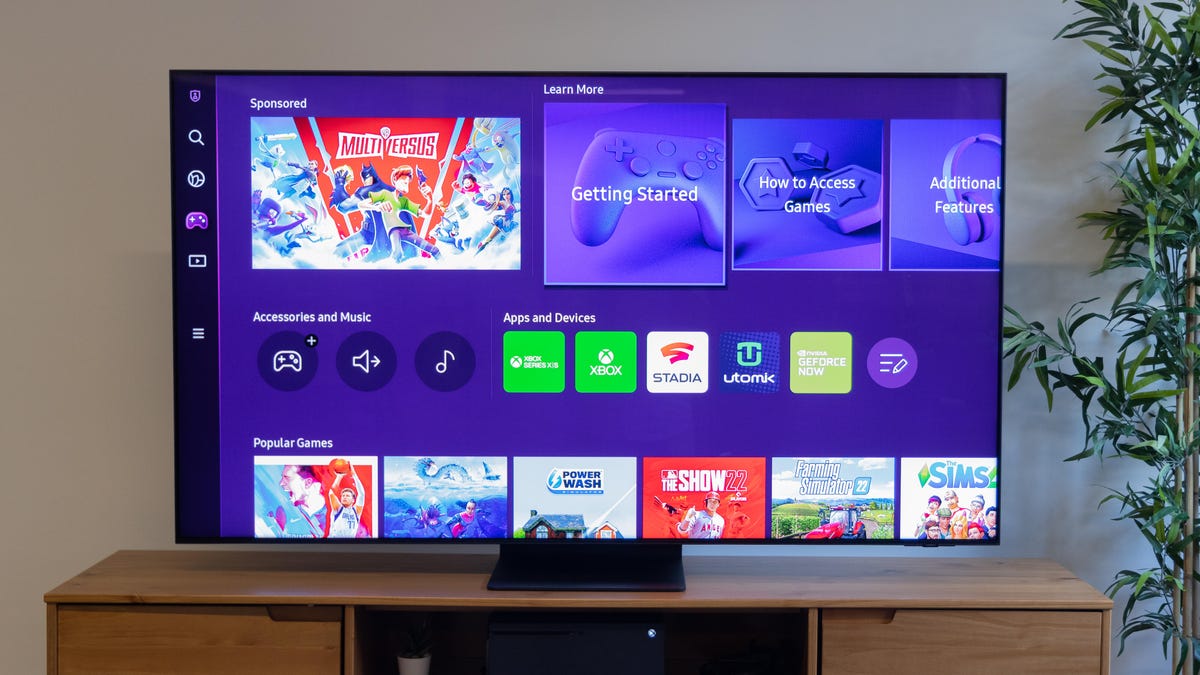
A new feature for 2022 is Samsung's game hub, which features cloud gaming from services like Xbox Game Pass and Google Stadia, as well as quick access to connected video game consoles.
Bobby Oliver/CNET
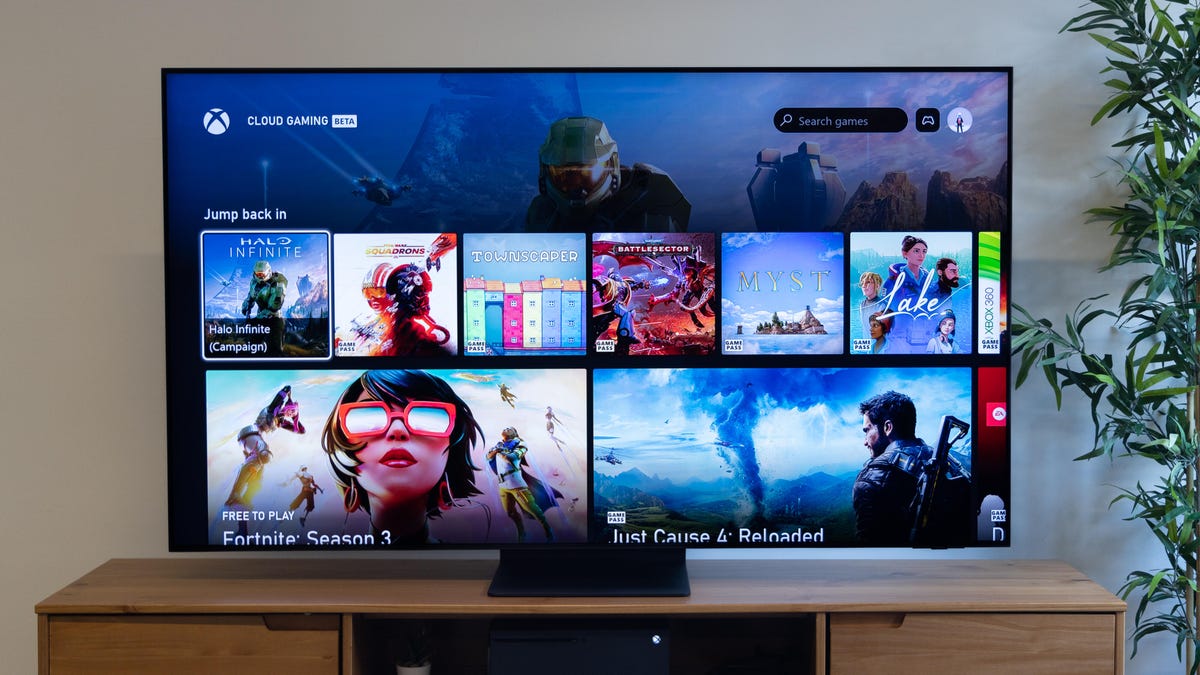
Like all Samsung TVs the QN90B has Samsung's new gaming hub, which connects to cloud gaming services including Xbox Game Pass, Google Stadia, Nvidia GeForce Now and Amazon Luna. I tried it out with a fast wired Ethernet connection, as Samsung recommends, and the experience playing Halo: Infinite was pretty good. My Xbox controller paired easily to the TV and responses were quick as I fought grunts and rode the Mongoose across the map. Graphics were quite a bit softer than the game on an Xbox Series X, as expected, but gameplay was similar.
As with all cloud services your mileage may vary. I tried out a much slower Wi-Fi connection, for example, and the game was unplayable. But assuming you have a good connection (Samsung recommends 50 Mbps or more), the ability to play games using just the TV, without needing a console at all, is really cool.
Xbox Game Pass Ultimate on Samsung TVs lets you play games directly on the TV using cloud streaming, no console required.
Bobby Oliver/CNET
As with last year you can choose between Alexa, Google Assistant and Samsung's own Bixby for your voice assistant, accessible by speaking into the remote or via speaking the wake word ("Alexa," for example) into thin air. (The always-listening mic can be disabled if you want.) The TV also works with Apple AirPlay.
Cutting-edge LCD TV tech
The most important image quality feature on the QN90B is that Neo QLED, mini-LED powered backlight with full-array local dimming. Local dimming improves LCD image quality by making certain areas of the picture dimmer or brighter in reaction to what's on the screen, which significantly boosts contrast, while CNET's testing has found mini-LEDs are brighter than larger ones. Judging from Samsung's obscure "quantum HDR 32X" spec the QN90B has more dimming zones and brighter images than the step-down Q85B, and fewer zones than the 8K models, but Samsung doesn't say exactly how many zones (or how bright). It does tout new-for-2022 "shape adaptive light control" processing, said to reduce blooming and stray illumination, and it seems to work well.
Key features
Display technology
LED LCD
LED backlight
Full array with local dimming
Resolution
4K
HDR compatible
HDR10, HDR10 Plus
Smart TV
Samsung Smart Hub
Remote
Voice with USB, solar recharging
Like all of Samsung QLED TVs, as well as most higher-end TVs from Vizio, Hisense and TCL, the QN90B's LCD panel is augmented by a layer of quantum dots -- microscopic nanocrystals that glow a specific wavelength (that is, color) when given energy. The effect is better brightness and color compared to non-QD-equipped TVs. The QN90B uses a true 120Hz panel, which improves the TVs' motion performance.
The set supports high dynamic range content in the HDR10 and HDR10 Plus formats. Samsung TVs lack the Dolby Vision HDR support found on most competitors' HDR TVs. I've seen no evidence that one HDR format is inherently "better" than the other, so I definitely don't consider the lack of Dolby Vision a deal-breaker on this TV.
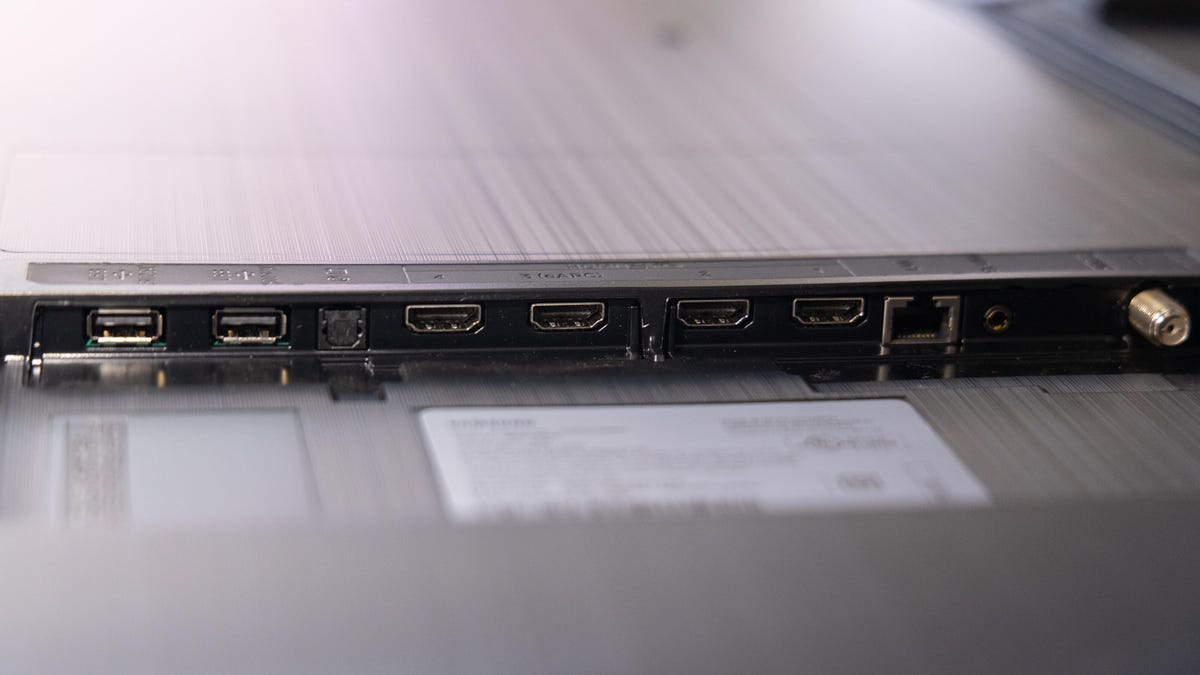
Connectivity is ample on the Samsung QN90B TV, with 4 HDMI that can all handle 4K/120Hz signals, 2 USB ports, an Ethernet connection and more.
Bobby Oliver/CNET
Connectivity is excellent. All four of its HDMI inputs are compatible with 4K/120Hz signals, so if you have multiple devices that output it -- like a PlayStation 5 and an Xbox Series X and a high-end PC card (you know who you are...), you're all set. The QN90B also handles variable refresh rate, including AMD's FreeSync Premium Pro and standard VRR formats, ALLM (also known as Auto Game Mode) which lets it automatically switch to game mode to reduce input lag when it detects you're playing a game, and eARC.
Four HDMI inputs with HDMI 2.1, HDCP 2.2
Two USB 2.0 ports
Optical digital audio output
RF (antenna) input
RS-232 port (minijack, for service only)
Ethernet (LAN) port
The list is mostly solid, unless you happen to own a legacy device that requires analog video (component or composite) or audio. Like many new high-end TVs the QN90B lacks analog inputs entirely, audio or video. On the flipside, it is one of the few TVs with a built-in ATSC 3.0 tuner for Next-Gen TV signals.
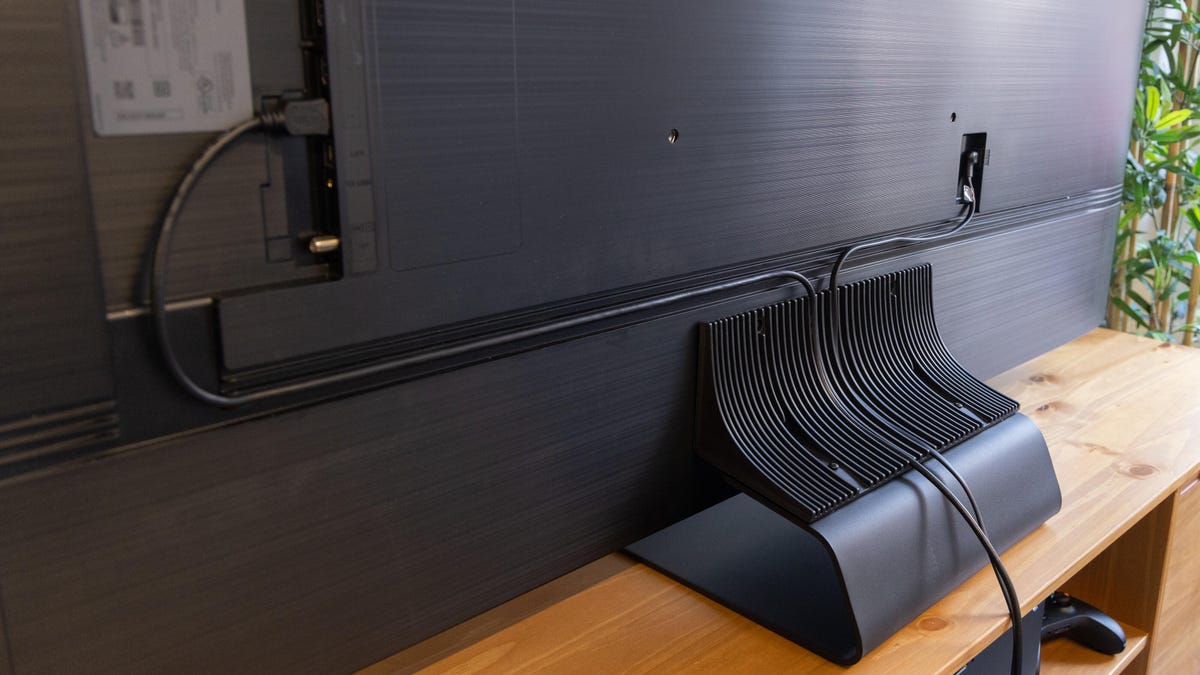
The channels also run the length of the TV from the power cable to the input section.
Bobby Oliver/CNET
Picture quality comparisons
For my comparisons I set up the Samsung QN90B next to two other high-end TVs, the Sony KD-65X95K, another mini-LED-equipped model, and the LG OLED65C1P, an OLED-based TV and my current Editors' Choice. I would have liked to use the newer C2 in my comparison but it wasn't available, and the C1 is a good substitute since the two have similar picture quality.
TV and movies: As usual I started my comparison with the montage from the Spears and Munsil HDR benchmark, and the Samsung's brightness advantage over the other two was immediately apparent. The snowcapped mountains, desert sand, clouds and other well-illuminated areas had more impact next to the Sony and LG. Meanwhile in dark scenes with mixed content, like a nighttime cityscape, the LG looked more natural with truer shadows, while the Samsung and Sony appeared slightly more washed-out. The color of the white snow and other areas on the Samsung also looked a bit bluer and less-accurate than the others, but it's nothing that would be noticeable outside of a side-by-side comparison.
Movies Coming in 2022 From Marvel, Netflix, DC and More
The Samsung did a superb job of controlling blooming, or stray illumination that can leak into dark areas from adjacent bright ones. In the montage's difficult black-background scenes, for example the pen tip and the honey dripper, I saw only very faint brightness near the edge of the brightest objects on the Samsung while the Sony was worse. Especially considering its brightness the QN90B's lack of blooming is remarkable, although of course the OLED didn't show any blooming whatsoever.
Switching to an actual movie, The Gray Man on Netflix, the LG pulled ahead a bit. In the dramatic dark scenes like the initial interrogation or the Bangkok nightclub, the OLED TV's ability to preserve darkness in shadows game it a more theatrical look. The Samsung was still excellent, however, and the brightness advantage in the fireworks over the city, for example, was clear over the dimmer OLED. Again the Sony trailed the other two slightly, with dimmer highlights than the Samsung and more obvious blooming, particularly in the letterbox bars.
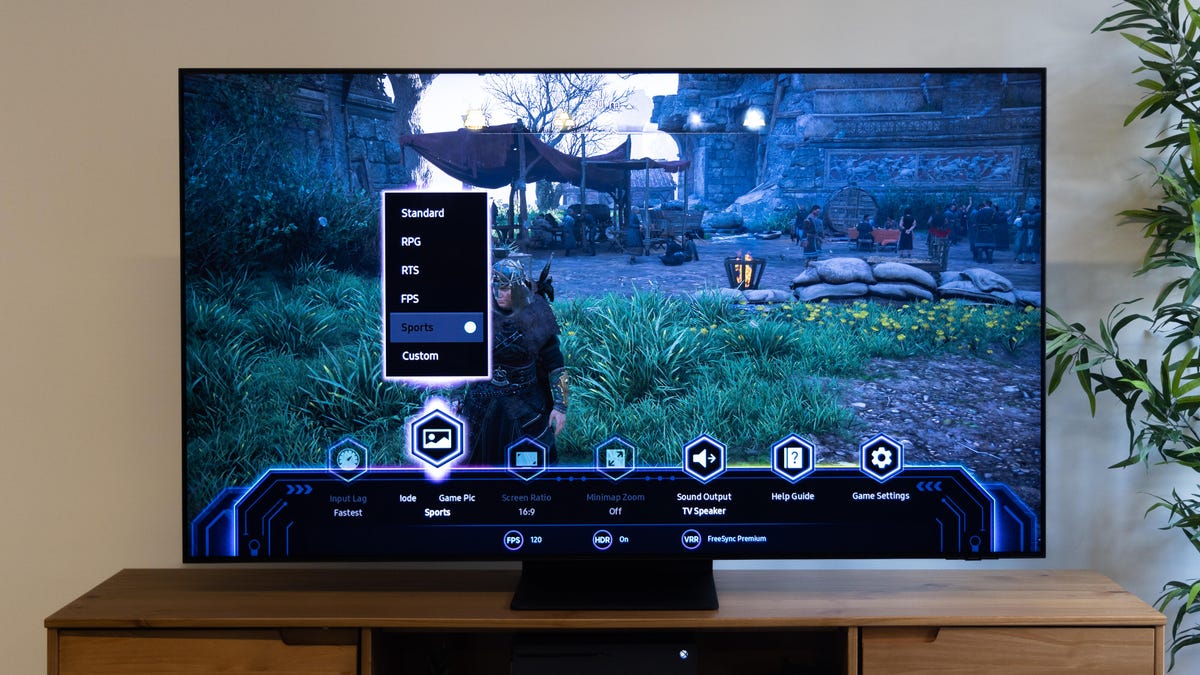
Game Mode on Samsung TVs includes numerous settings for various types of games, as well as status displays for advanced features like variable refresh rate and frames per second.
Bobby Oliver/CNET
Gaming: The QN90B is a very good gaming TV but I liked image quality in game mode on the other two better. Playing Stray on the PS5, colors looked over-saturated and inaccurate in most of the Samsung's modes, making the leaves of the foliage appear lime-colored, for example. The exception was Sports mode, which tamed colors (especially green) somewhat and brought them somewhat closer to the more-accurate LG and Sony. Of the other picture modes – Standard, RGP, RTS, FPS and Custom – I found it difficult to see any difference between the first four.
I also noticed occasional banding in bright-to-dark areas of Stray, for example around the lights when the kitty fell down the sewer and the picture faded to black and then back up. The LG and Sony looked smooth by comparison. In certain mixed scenes the Samsung's brightness was too much in a dark room, and I ended up using Custom picture mode and reducing brightness from the default 50 to around 10, but that's mainly a matter of personal preference and room lighting.
I did appreciate that the TV automatically detected my Xbox and switched to game mode, and that the game bar displayed status icons for various settings, confirming when I was using VRR or 120 frames per second, for example. Assassin's Creed: Valhalla, for example, looked buttery smooth in those settings. There are three choices to reduce input lag and I kept it on "Fastest," which measured a respectable 10 milliseconds, compared with 14ms and 23ms for "Faster" and "Fast," respectively.
Bright lighting: The QN90B is technically the brightest TV I've ever tested, beating out the Hisense U8G in its brightest settings. I say "technically" because its Dynamic numbers, listed below, are badly inflated. Even so it's exceedingly bright in its accurate modes too, especially compared to competing OLED models.
Light output in nits
TV
Brightest mode (SDR)
Accurate mode (SDR)
Brightest mode (HDR)
Accurate mode (HDR)
Samsung QN65Q90B
2,625
974
3,316
1,981
Hisense 65U8G
1,619
1,612
2,288
2,288
Sony KD-65X95K
1,268
421
1,400
1,305
TCL 65R635
1,114
792
1,292
1,102
Vizio P65Q9-J01
1,099
463
1,130
762
LG OLED65C2
413
389
812
759
LG OLED65C1
409
333
790
719
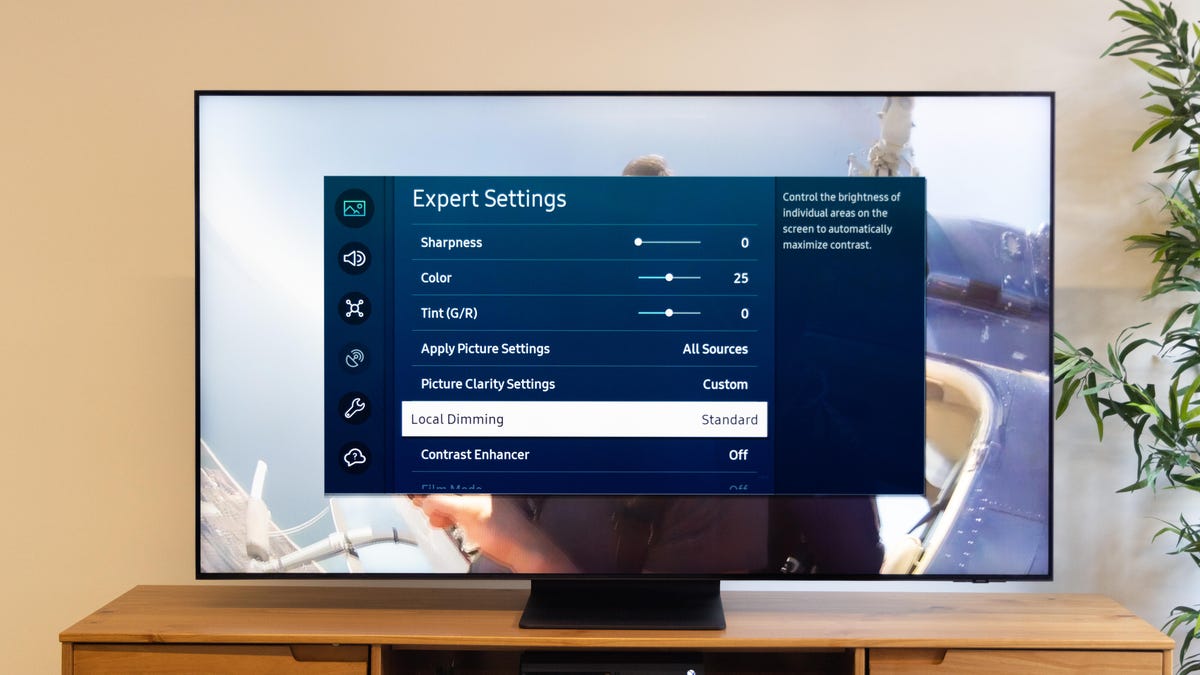
As usual the Samsung's brightest setting, Dynamic, has woefully inaccurate color. For the accurate measurements I used Movie mode with both HDR and SDR, although for SDR the Movie number was achieved by setting the local dimming to High (go to Home > Menu > Settings > All Settings > Picture > Expert Settings > Local Dimming).
The QN90B maintained steady HDR light output over time in Movie and Filmmaker modes, but in Dynamic mode with both HDR and SDR it fluctuated significantly, starting out at 3,300 and 2,600 nits respectively but falling almost immediately to around 500 -- almost a sevenfold decrease, which is massive. I've seen that behavior on past Samsung TVs as well and it seems designed to achieve prominence in charts like the one you see above. No other TV brand I've tested shows anywhere near that level of brightness change. This issue in Dynamic mode isn't a huge deal for me, however, because I don't recommend using that mode anyway.
Samsung's light-rejecting screen remains the best in the business, maintaining contrast and punch in bright lighting, and reducing reflections, better than the Sony and the LG. The screen, combined with the QN90B's prodigious light output, make it the best TV I've ever tested for bright rooms.
Uniformity and viewing angle: With test patterns I saw minor variations in brightness across the Samsung's screen, more so than the Sony and LG, but I didn't notice them during regular video. From off-angle seats to either side of the sweet spot directly in front of the TV, the two LCDs lost color and black level fidelity at about the same rate, while the LG was essentially perfect. The Sony's blooming was more noticeable from off-angle, however.
In-depth picture settings on the Samsung QN90B include adjustments for its full-array local dimming feature, among many others.
Bobby Oliver/CNET
Picture setting and measurement notes
The default Movie and Filmmaker modes were the most accurate, and pretty much equally so. For HDR, grayscale in bright areas was less-accurate (skewed too much toward green) than I expected in the default Warm 2 setting – switching to Warm 1 helped a bit (it was still too blue, but better) so that's what I'd recommend using. For the Geek Box measurements below I went with Filmmaker/Warm 1. In its favor the Samsung's EOTF for HDR was excellent.
Some other reviewers have reported that 2022 Samsung TVs, namely the S95B QD-OLED TV and the QN95B QLED TV, "cheated" measurements by improving brightness and accuracy with standard 10% window patterns. When using non-standard-sized windows, they reported significantly less-accurate color as well as lower brightness.
I did not see evidence of cheating on my Samsung-supplied QN90B review sample. I took measurements with various non-standard grayscale window sizes (7%, 9%, 11% and 13%) in HDR (Filmmaker mode) and they were quite consistent in terms of peak brightness, color accuracy and EOTF compared to the standard 10% window. The same goes for 9% and 10% windows with color patterns (ColorMatch HDR). I also measured peak brightness over time and for a two-minute period the image maintained a healthy 1900-ish nits in Filmmaker mode (although as mentioned above, it fluctuated wildly in Dynamic). I don't doubt the reports of other reviewers, but for whatever reason I didn't experience this issue.
Smoothing, also known as the soap opera effect, is completely disabled in Filmmaker Mode, which I prefer for TV shows and movies. In Movie mode there's more-noticeable smoothing turned on by default (Judder Reduction = 3), but you can adjust it to your heart's content by choosing a preset or tweaking the Custom sliders (Menu > All Settings > Picture > Expert Settings > Picture Clarity Settings > Custom).
Geek Box
Test
Result
Score
Black luminance (0%)
0.003
Good
Peak white luminance (SDR)
2625
Good
Avg. gamma (10-100%)
2.14
Good
Avg. grayscale error (10-100%)
3.85
Average
Dark gray error (30%)
3.31
Average
Bright gray error (80%)
5.21
Poor
Avg. color checker error
3.27
Average
Avg. saturation sweeps error
3.51
Average
Avg. color error
2.97
Good
1080p/24 Cadence (IAL)
Pass
Good
Input lag (Game mode)
10.73
Good
HDR10
Black luminance (0%)
0.003
Good
Peak white luminance (10% win)
3315
Good
Gamut % UHDA/P3 (CIE 1976)
94.71
Average
ColorMatch HDR error
2.50
Good
Avg. color checker error
2.10
Good
Input lag (Game mode, 4K HDR)
10.50
Good
See How We Test TVs for more details and explanations of the Geek Box results.
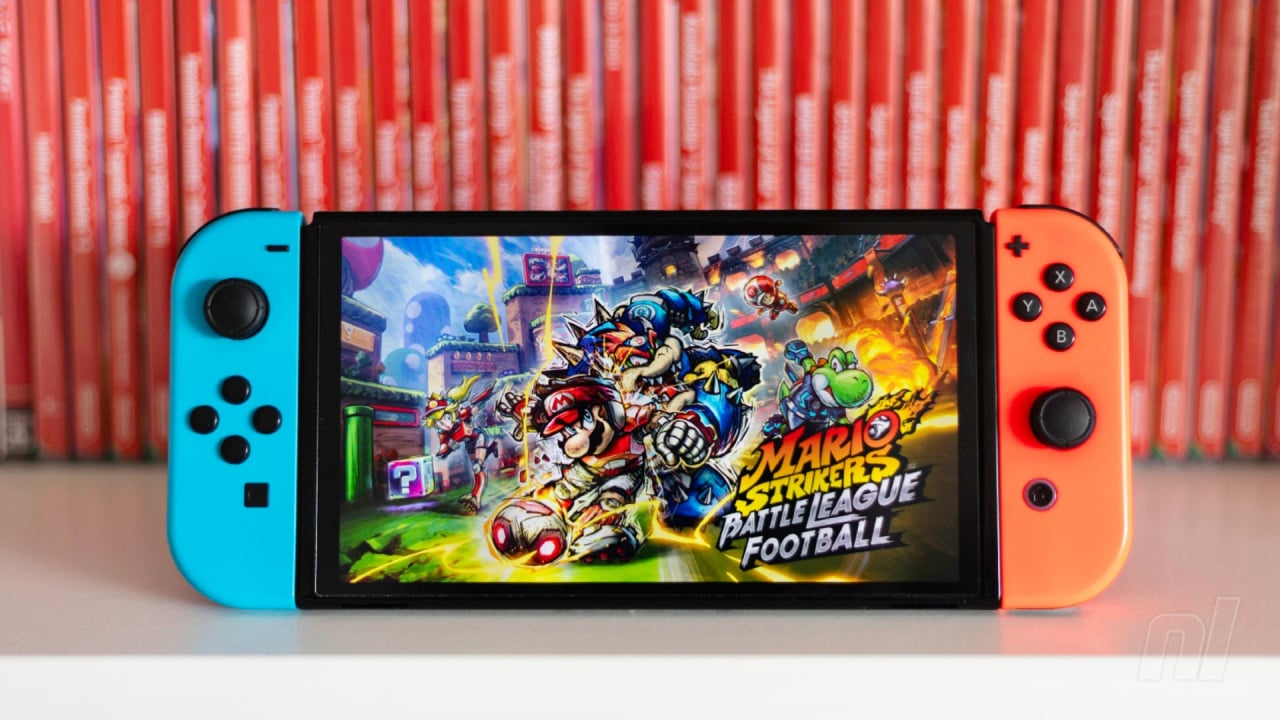
Nintendo's latest financial report for Q1 2023 (April - June 2022) has been published, and the Switch has just surpassed 111 million units sold.
However, as with last quarter, there's been a drop in year-on-year sales. Citing the ongoing semiconductor shortage — and comparing this quarter's major releases to the same quarter last year (and Animal Crossing: New Horizon's huge sales back then) — Nintendo reports a drop of 22% in the latest quarter.
Despite this, the company states that demand for the console is stable in all regions, and the outlook is looking a bit better in terms of semiconductors. Nintendo believes that the situation will be gradually improving from late summer to early autumn, which should boost console production nicely.
Total Standard Switch sales this period: 1.32 million
Total Switch OLED sales this period: 1.52 million
Total Switch Lite sales this period: 0.59 million
The Switch is ever so slowly creeping up on the Game Boy's sales, which sit at 118.69 million units. It's fairly likely the console will overtake the blocky handheld in the next financial year or so, which will be pretty incredible!
Here's how the console sales currently stack up
Console
Total Sales
DS
154.02 Million
Game Boy
118.69 Million
Switch
111.08 Million
Wii
101.63 Million
Game Boy Advance
81.51 Million
3DS
75.94 Million
Family Computer / NES
61.91 Million
Super Family Computer / SNES
49.10 Million
N64
32.93 Million
GameCube
21.74 Million
Wii U
13.56 Million
Next quarter should be rounding off nicely with Splatoon 3, which is a huge seller in Japan in particular. And don't forget about that lovely-looking Splatoon OLED model. Xenoblade Chronicles 3 has also just come out, and it'll be interesting to see if this new release drives console sales for the next quarter.
So, despite a drop in sales year-on-year, things still look solid for Nintendo and the Switch.
What do you think of the latest sales figures? Do you think the Switch will catch up to the Game Boy before the end of the year? Let us know!
Samsung has made great strides over the past few years with its update cadence throughout the entire device lineup. With that in mind, here’s every smartphone and tablet that Samsung has updated with the August 2022 security patch.
Samsung August 2022 security update – what’s new
Almost all security updates include a number of important security fixes, most of these include general Android tweaks, but there are some that are specific to Samsung devices. The Korean firm has yet to release full details of the August patch, so at this stage, we’re not entirely sure just what has been resolved. However, we’ll learn more once the Android Security Bulletin has been shared.
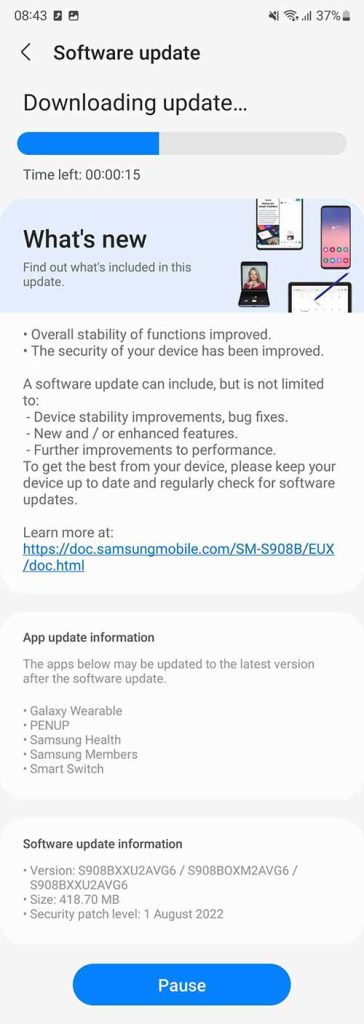
The patch notes from the OTA file note that several Galaxy apps have been updated for selected handsets with Samsung Health, Samsung Members, and Smart Switch all noted.
Table of contents
Devices with the Samsung August 2022 security update
As noted, Samsung has truly stepped up their game with regard to updates in recent years. In fact, Samsung even pushed the August 2022 security update out to devices as early as July 28. This will no doubt expand to a wide array of handsets over the coming days and weeks as more OTA updates arrive on the plethora of Samsung Galaxy phones and tablets across the globe.
This list will include a note on where the update first debuted and if it is also available in the United States. As usual, the latest additions will be marked in bold.
Galaxy S series
As the flagbearer of Samsung’s smartphone efforts, it should come as no surprise that the Galaxy S series is at the very forefront of the update schedule each and every month. The latest Galaxy S series devices are often among the very first on Android to get the latest security patch.
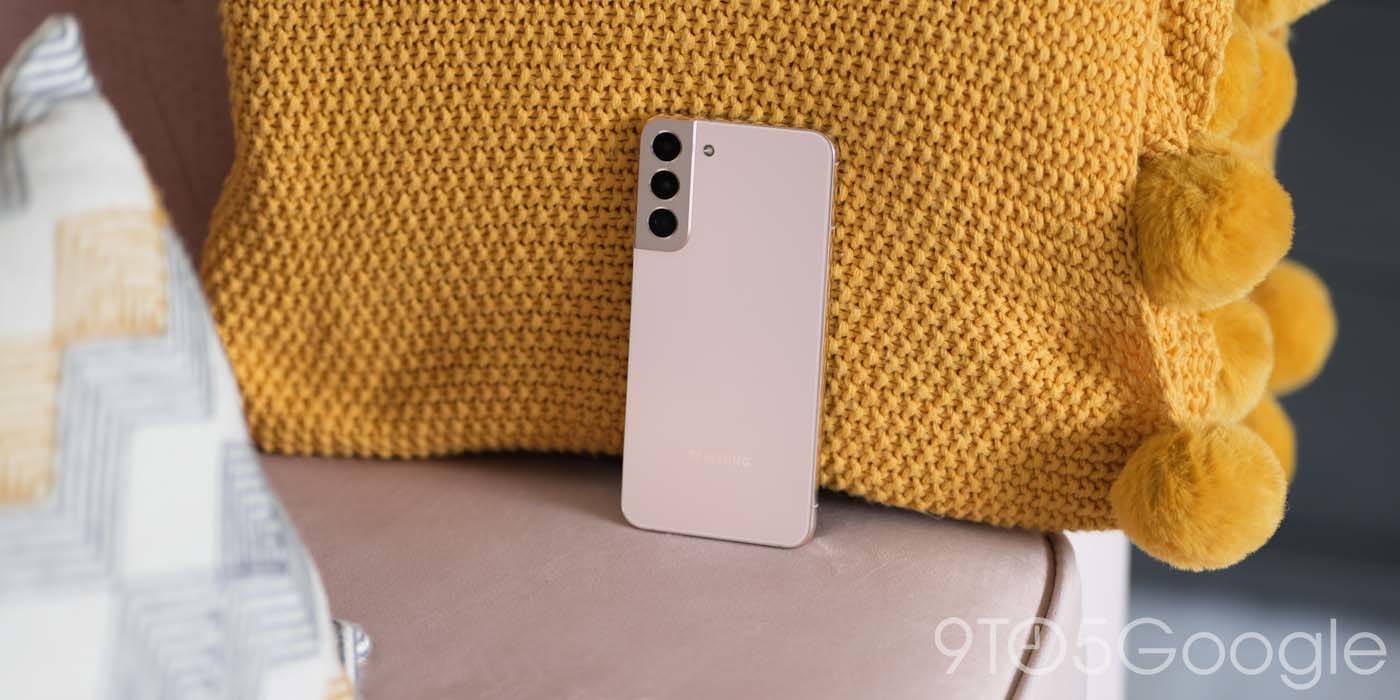
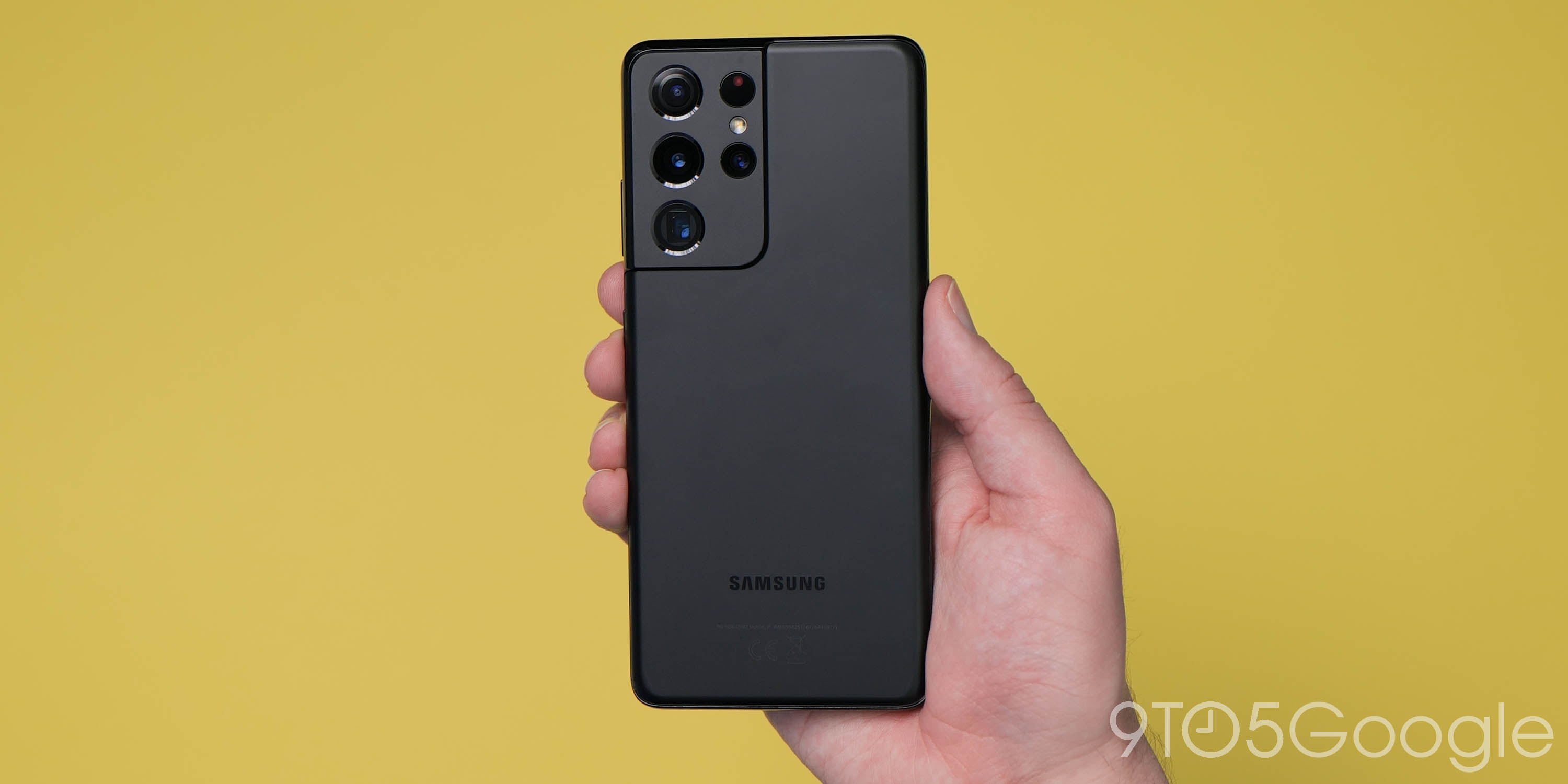
That has proven true with the August 2022 security update, as the Samsung Galaxy S22 series saw the patch in selected regions from July 28. This patch weighed in at around 420MB and includes some tweaks to the PenUP application alongside some core Samsung apps including the Galaxy Wearable application. What’s more impressive is that the Galaxy S21 and S20 series were updated merely hours after in European markets too.
Galaxy S22 / S22+ / S22 Ultra — S901BXXU2AVG6 (Released first in Europe)
Galaxy S21 / S21+ / S21 UItra — G99xBXXU5CVGB (Released first in Europe)
Galaxy S20 / S20+ / S20 Ultra —G98xBXXUEFVG5 (Released first in Europe)
Galaxy Note series
The recent release of the Galaxy S22 Ultra essentially puts the final nail in the Galaxy Note series coffin. Even despite the lack of new hardware since 2020, Samsung continues to push updates to any existing and supported Note handsets.
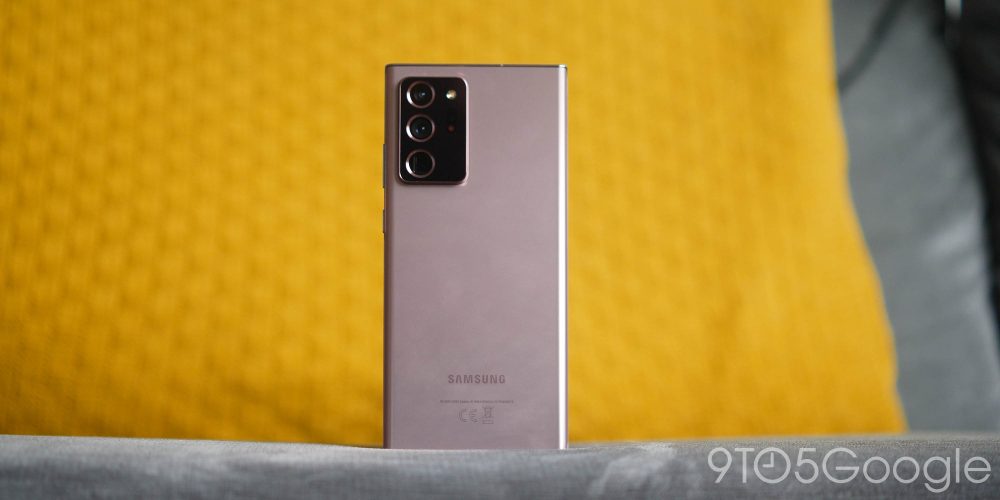
Carrier-locked versions of the Samsung Galaxy Note 20 are starting to see the August security according to SamMobile. This includes the Note 20 and Note 20 Ultra but it’s not entirely clear just what networks the OTA update is available on at this stage. Now might be the time to check if do own a carrier-locked model of the Note 20.
Galaxy Note 20 / Note 20 Ultra — N98xU1UEU2FVG5
Galaxy Flip series
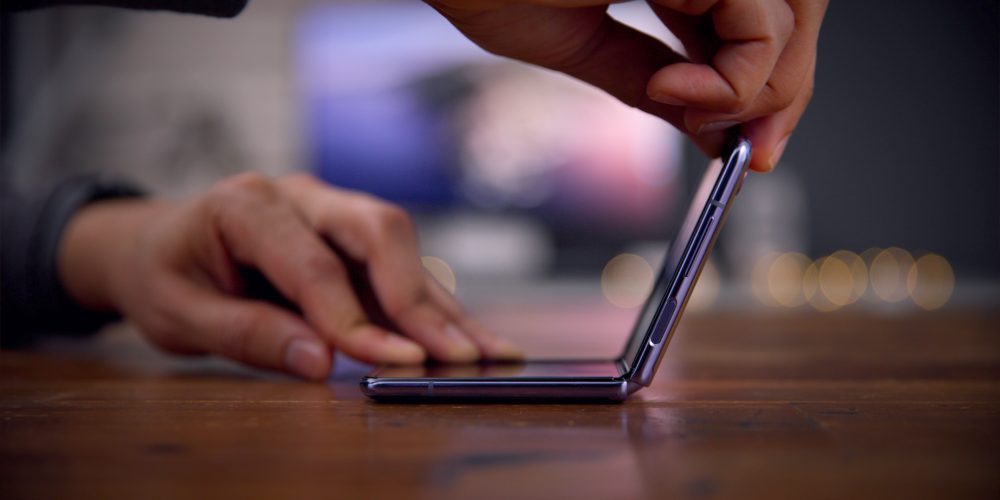
The Galaxy Flip series is arguably third in the Samsung smartphone rankings behind the Fold and S lines. We’re expecting to learn more about the fourth generation in the coming weeks but until then, those with the original Samsung Galaxy Flip 5G are being updated with the August 2022 security patch. Devices in Switzerland are among the first to get the OTA update, with more expected over the coming days.
Galaxy Z Flip 5G — F707BXXU6GVG5 (Released first in Switzerland)
How to check for the latest OTA on your Galaxy device
If your device is slated to have been updated already, but the patch hasn’t arrived for you personally, you can try updating manually. Simply open the Settings app, tap “Software update,” and choose “Download and install.”
This article was first published on July 28 and most recently updated on August 1.
Intel is planning to install its next-generation Wi-Fi 7 (802.11be) technology in devices by 2024, ETNews reports.
Wi-Fi 7 is the successor to Wi-Fi 6E (802.11ax), bringing two times faster data processing speeds of 5.8 Gbps and more stable 6 GHz bandwidth stability, as well as support for up to 36 Gbps when working with data. Intel plans to expand its Wi-Fi 7 development efforts ahead of its introduction to the market in 2024 and intends to apply its technology predominantly in laptops before expanding to other devices.
"We are currently developing Intel's Wi-Fi '802.11be' in order to obtain the 'Wi-Fi Alliance' certification, and it will be installed in PC products such as laptops by 2024. We expect it to appear in major markets in 2025," Eric McLaughlin, vice president of Intel's wireless solutions division, said at a recent press conference in Asia.
"Wi-Fi 7 almost doubles the frequency bandwidth of 802.11ax (170 MHz) to 320 MHz and doubles the speed of Wi-Fi. Since there is more than a year left before the release of 802.11be, there is still a chance that we could improve the processing speed even further," he added.
Meanwhile, Apple is on the cusp of transitioning its devices to Wi-Fi 6E. While it was heavily rumored to debut with the iPhone 13 lineup last year, Apple has yet to release any devices with support for Wi-Fi 6E. That is expected to change this year starting with the iPhone 14.
Apple's long-rumored mixed-reality headset is also expected to feature Wi-Fi 6E. Apple analyst Ming-Chi Kuo said that head-mounted display devices in 2022, 2023, and 2024 will offer Wi-Fi 6/6E, Wi-Fi 6E/7, and Wi-Fi 7, respectively, but it is unclear if this information was related to Apple's product roadmap specifically.
Wi-Fi 6E offers the features and capabilities of Wi-Fi 6, including higher performance, lower latency, and faster data rates, extended into the 6 GHz band for processing speeds of 2.4 Gbps. The additional spectrum provides more airspace beyond existing 2.4GHz and 5GHz Wi-Fi, resulting in increased bandwidth and less interference.
Last year, the FCC adopted rules that make 1,200 MHz of spectrum in the 6 GHz band available for unlicensed use in the United States, paving the way for the introduction of new devices with Wi-Fi 6E support.
Along with Intel, Qualcomm, Broadcom, and MediaTek are also preparing to release Wi-Fi 7-based products.
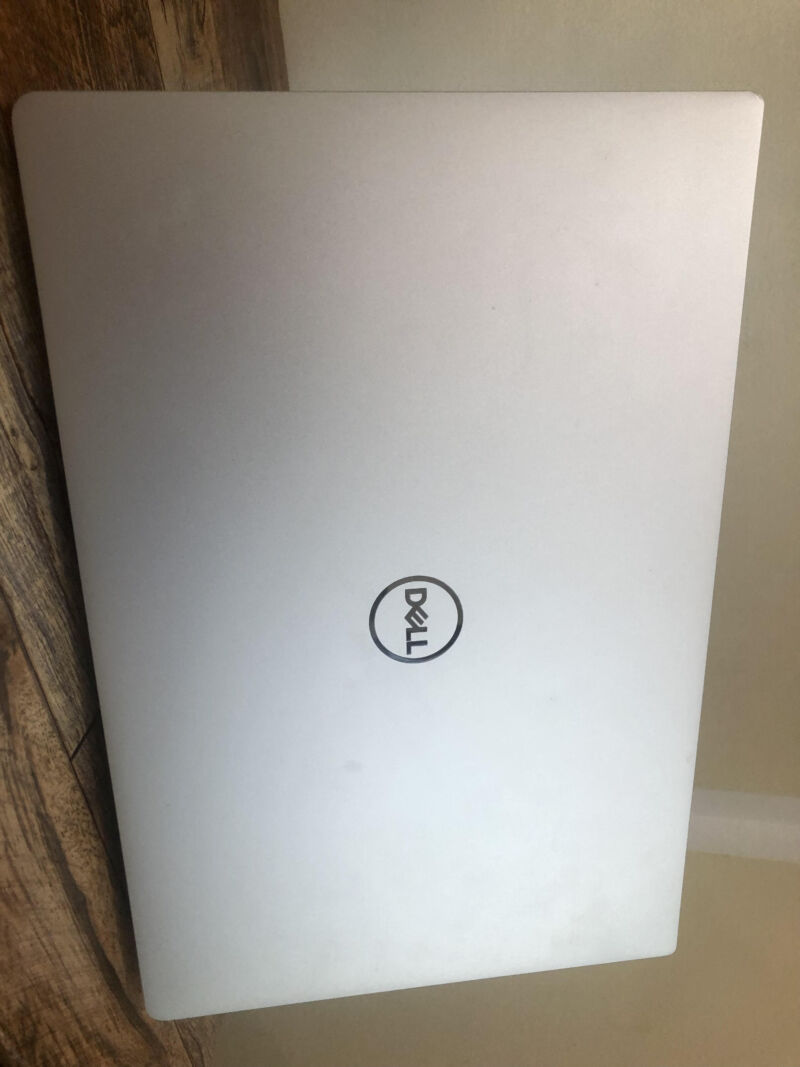
A recently published Dell patent, spotted by Patently Apple, shows the company exploring the ability to wirelessly charge devices on a laptop's surface. We've seen similar concepts from Apple, which has already won patents for similar technologies. However, instead of simply dropping your iPhone on the laptop's surface and letting it charge, Dell's patent application describes a "wireless charging clip" that can attach to the PC and then be used to charge devices placed on top of it.
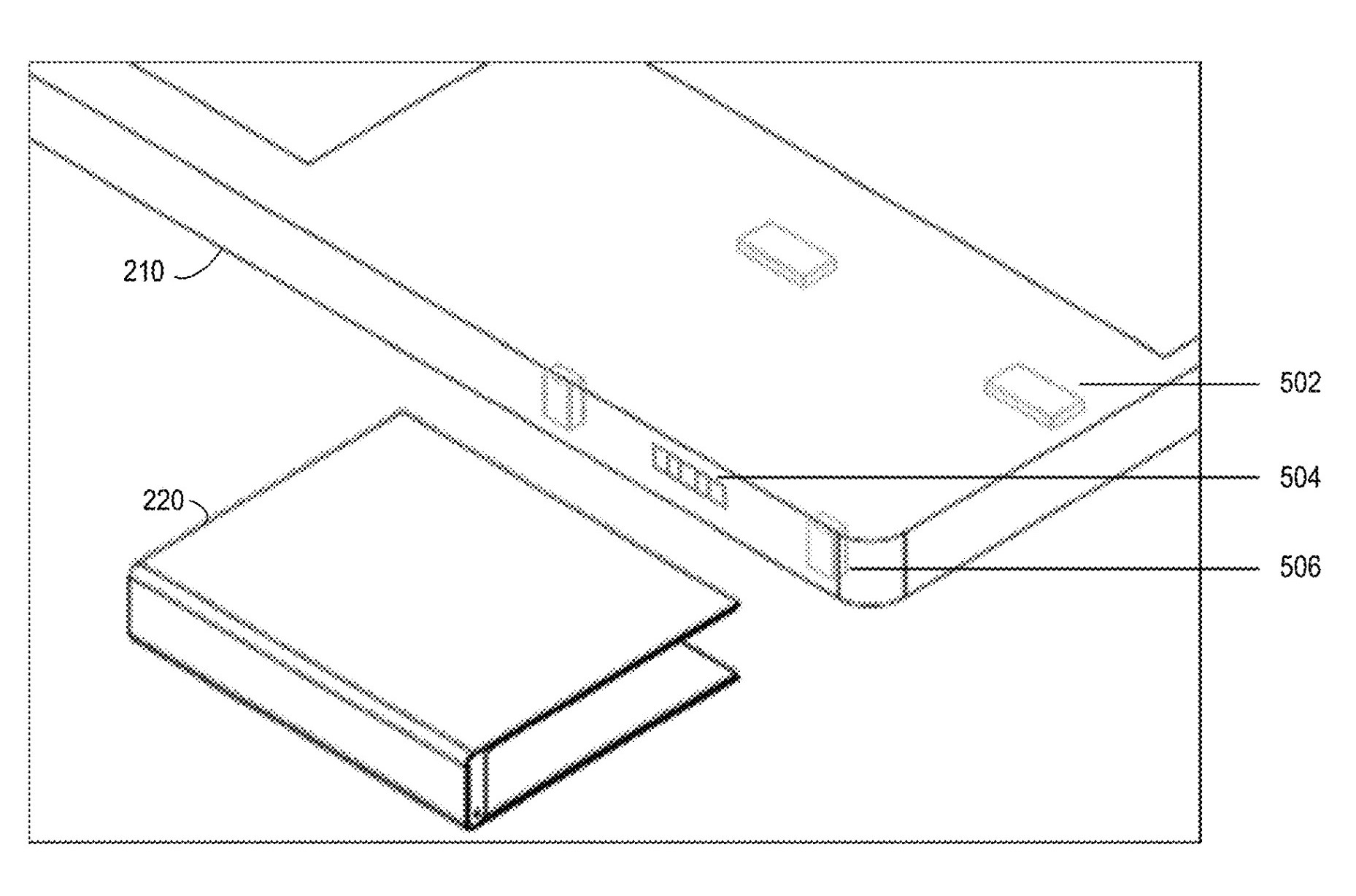
Enlarge/ The clip would attach to the computer, giving it the ability to wirelessly charge other devices.
Dell
The patent (number 20220239124) was filed in early 2021 and was published Thursday. It doesn't guarantee a future product or feature, but it gives us a peek into what the company is considering.
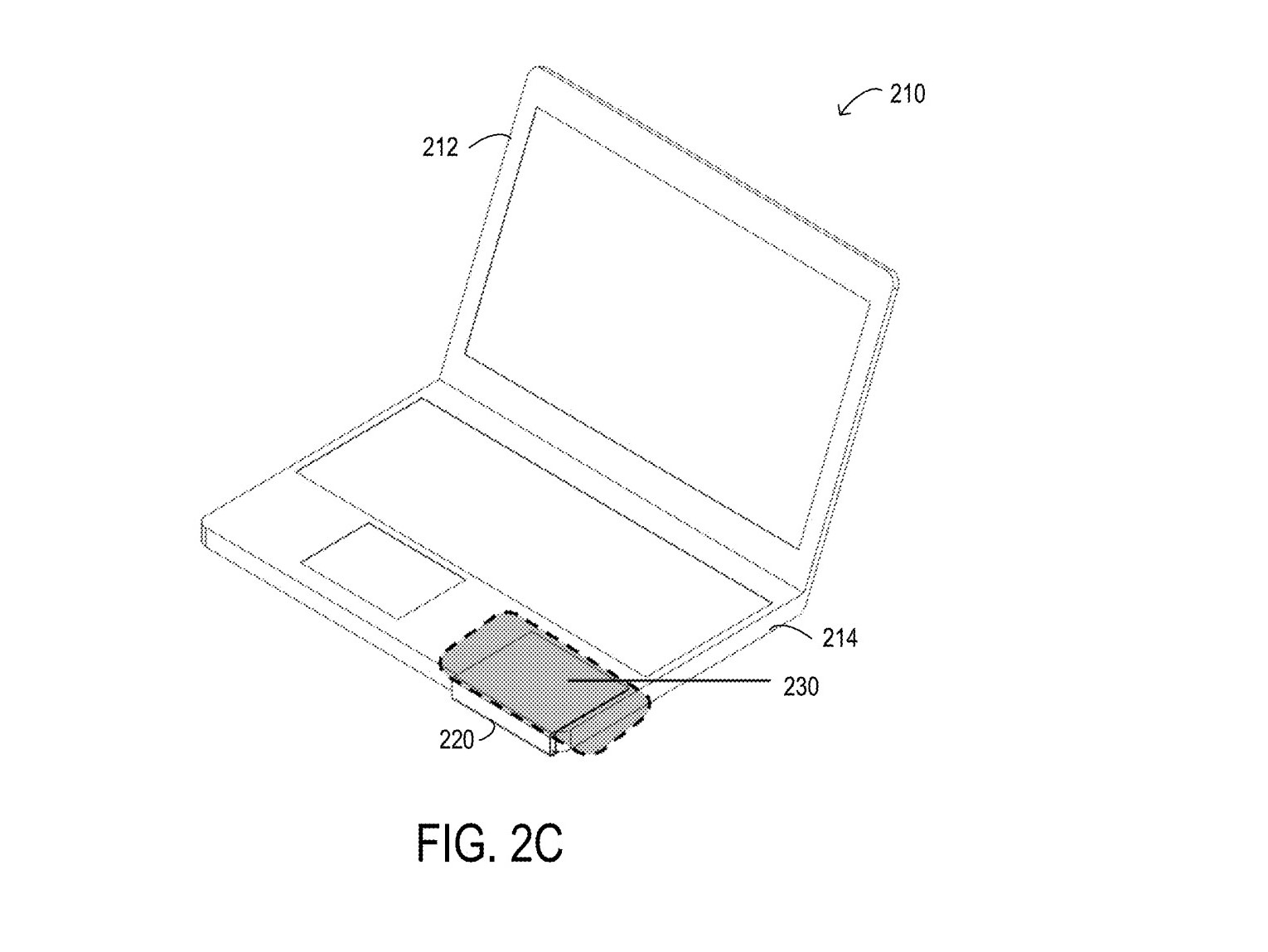
Enlarge/ The diagram shows a smartphone charging on a Dell laptop.
Dell
The wireless charging clip has a surface with a charging coil and a ferrite sheet beneath. The clip would be connected to the PC by magnets.
According to the patent application, the wireless charging clip uses "charging circuitry configured [to] supply inductive power to charge an auxiliary device when the device is placed on top of the first surface, and a connector through which input power is received" from the system that has the charging clip installed.
Apple has been exploring bringing inductive charging into its devices for years. The US Patent and Trademark Office has already awarded Apple patents that use the surface, trackpad, or lid of a MacBook to wirelessly charge Apple products.
Again, it's not certain that either Dell or Apple will release a laptop that supports reverse wireless charging in some form. After all, we've seen products like Apple's AirPower wireless charging mat fail to make it to market before.
Worldwide regulators are asking competitors like Sony for comments on Microsoft's Activision-Blizzard buyout and how it could affect competitor's positions in the market. Sony had a few choice words to say about Activision's most popular franchise.
Call of Duty is the top shooter series of all time. It's a powerhouse franchise that helps Microsoft and Sony generate combined billions every year (even with the 30% split). We've already calculated that Sony (and Microsoft) would lose hundreds of millions if Call of Duty is kept off of PlayStation platforms should Microsoft's $68.7 billion Activision-Blizzard deal close, but Sony has delivered official comments reiterating how important Call of Duty is for gaming.
In an official response to Brazil's Administrative Council for Economic Defense (CADE), as found on this webpage and machine translated for this article, Sony legal representation said that Call of Duty is unrivaled in the games industry. Representation indicates that Call of Duty exclusivity could be a paradigm shift for the games market.
"No other developer can devote the same level of resources and expertise to game development. Even if they could, Call of Duty is heavily entrenched, so that no rival - no matter how relevant - can overtake it. Call of Duty has been the top-selling game for nearly every year over the past decade, and for its genre, it's overwhelmingly the best-selling game. It is synonymous with first-person shooters and essentially defines that category."
While not explicitly clear, Sony's comments could be seen as an argument against platform exclusivity for the Call of Duty franchise.
Sony counsel does say, however, there isn't currently an exclusive franchise that could swing the balance of power across platforms.
"Exclusive games are a parameter of competition between Microsoft and SIE, although no company has so far developed or acquired an exclusive game that has decisively shifted the balance in favor of a console. This is because proprietary exclusive games are less popular and represent less revenue than third-party AAA games, which, until then, are available on Xbox and PlayStation."